Massachusetts law lets you use force to protect someone else, not just yourself. If you stepped in to help a person who appeared to be under attack, and a reasonable person in your position would have done the same, you are not guilty. Like self-defense, defense of another is a complete defense, and the Commonwealth must disprove it beyond a reasonable doubt. The rules come from the District Court model jury instruction on defense of another, Instruction 9.264.
At a Glance: Defense of Another
No burden on you
the Commonwealth must disprove it beyond a reasonable doubt
Your view counts
judged on the circumstances known to you, not the person you helped
Self-defense rules apply
could the other person have lawfully used that force themselves?
If it succeeds
not guilty: a complete defense
The source: District Court Model Jury Instruction 9.264 (Defense of Another, revised October 2024), with the self-defense instructions 9.260–9.263
What Defense of Another Means
A person is not guilty of a crime if they acted in lawful defense of another. The question is not whether the person you helped was, in hindsight, actually entitled to defend themselves. The question is what you believed, and what a reasonable person would have believed, based on what you knew at the time.
Defense of another usually comes up alongside self-defense, and the jury applies the law of self-defense to decide it.
The Commonwealth’s Burden
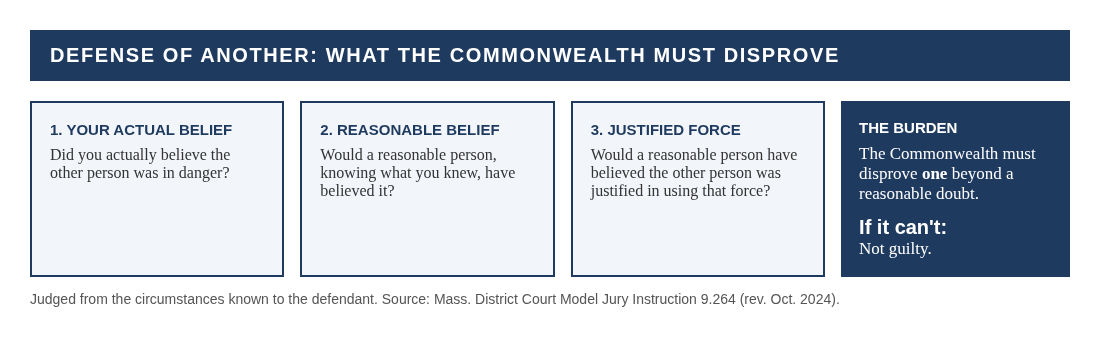
You do not have to prove you acted in defense of another. The Commonwealth must prove beyond a reasonable doubt that you did not. Under Instruction 9.264, it can do that by proving at least one of three things:
You did not actually believe the other person was in danger. The focus is on your belief, not on whether the other person actually felt threatened.
A reasonable person would not have believed it. A reasonable person, in the circumstances known to you, would not have believed the other person was in danger.
The other person was not justified in using force. A reasonable person, in the circumstances known to you, would not have believed the other person was justified in using that force to protect themselves.
If the Commonwealth cannot prove any of the three, the jury must find you not guilty.
Non-Deadly vs. Deadly Force
The level of danger required depends on the force you used. For non-deadly force, the question is whether the other person had a concern for their immediate personal safety. For deadly force, the question is whether the other person was in immediate danger of death or serious bodily harm from which they could save themselves only by using deadly force.
The instruction’s notes describe deadly force as force intended or likely to cause death or great bodily harm. It is measured by the level of force used, not by how serious the resulting injury turned out to be. When the evidence could support either level, the jury decides which one applies and receives instructions on both.
The Self-Defense Rules Still Apply
Because the jury asks whether the other person could have lawfully used force, the limits of self-defense carry over. In practice, that means asking whether the danger was immediate, whether the force was more than reasonably necessary, and whether the person you helped had safe ways to avoid the fight. Force used for revenge or after the danger has passed is not lawful defense of anyone.
Incidents Involving Police
When defense of another arises during an interaction with a police officer, Instruction 9.264 directs judges to the separate instruction on resisting arrest. Those rules are different, and the ordinary defense-of-another analysis may not apply.
Why a Lawyer Matters
These cases turn on what you saw and knew in the moment: who appeared to be the aggressor, what was said, and how fast it happened. Showing the jury the situation from your point of view is the heart of the defense. I have defended criminal cases for 23 years. If you were charged after stepping in to protect someone, contact my office or call 781-393-5900.
Related Topics
Self-defense: the rules for using force to protect yourself, which also govern this defense.
Defense of property: the narrower rules for using force to protect property.
Duress: a defense for crimes committed under an immediate threat from another person.
Resisting arrest (G.L. c. 268, § 32B): a separate charge, with separate rules, for confrontations with police.
This information is for general educational purposes only and not legal advice. Laws change. For advice about a specific case, speak with a licensed Massachusetts attorney.