Massachusetts law lets you use reasonable force to protect your property from theft, destruction, or trespass, but never deadly force. If you used force to keep your property, get it back, or remove a trespasser, and the force was reasonable and not deadly, you are not guilty. Once the issue is raised, the Commonwealth must disprove it beyond a reasonable doubt. The rules come from the District Court model jury instruction on defense of property, Instruction 9.265.
At a Glance: Defense of Property
Reasonable force only
never deadly force to protect property
Three situations
defend it, regain it, or remove a trespasser who refused to leave
Burden shifts
once raised, the Commonwealth must disprove it beyond a reasonable doubt
If it succeeds
not guilty
The source: District Court Model Jury Instruction 9.265 (Defense of Property, revised October 2024)
What Defense of Property Means
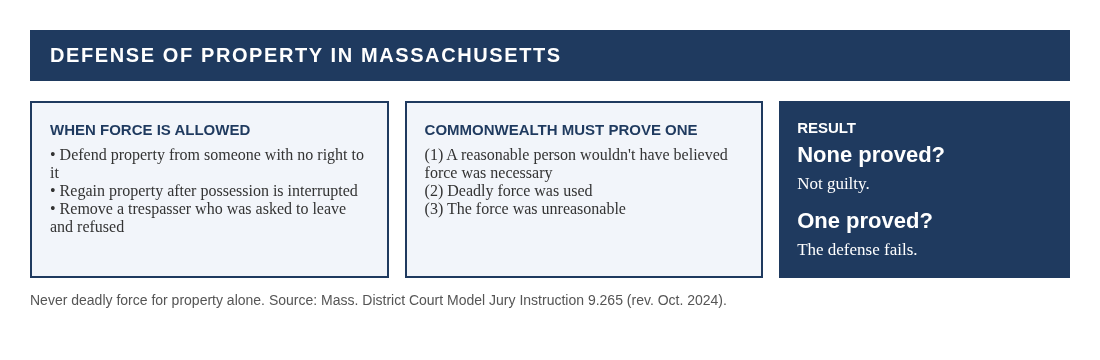
Under Instruction 9.265, a person has a right to use reasonable force to protect their real and personal property from trespass, theft, or destruction. The instruction covers three situations. In each, the force must be reasonable, and it may not be deadly:
Defending property against someone who has no right to it.
Regaining property when your possession has been interrupted by someone with no right to it.
Removing a trespasser from your property after the trespasser was asked to leave and refused.
Defense of property is a separate question from self-defense. If someone threatens you, not just your property, the self-defense rules apply to that threat.
The Commonwealth’s Burden
Once the defense has been properly raised, the Commonwealth must prove beyond a reasonable doubt that you did not act in defense of property. It can do that by proving at least one of three things:
Force wasn’t necessary. A reasonable person in your position would not have believed force was necessary to defend the property, regain it, or remove the trespasser.
Deadly force. You used deadly force.
Unreasonable force. The force you used was unreasonable.
If the Commonwealth cannot prove any of the three, the jury must find you not guilty.
No Deadly Force for Property
Deadly force is force intended or likely to cause death or serious bodily harm. It is measured by the level of force used, not by how badly anyone was actually hurt. Deadly force is never allowed to protect property alone.
How Much Force Is Reasonable
How much force is reasonable depends on the situation, and the instruction recognizes that exactness is not always possible. The jury may consider whether you had to decide how to respond quickly and under pressure. But a person who uses clearly excessive and unreasonable force becomes the aggressor and loses the right to claim defense of property.
Trespassers and Tenants
The trespasser rule has a built-in step: the person must first be asked to leave and refuse. Whether someone was in fact a trespasser is usually a question for the jury. And the notes to Instruction 9.265 make one limit clear: a residential landlord may not remove a tenant by force. Evicting a tenant requires court proceedings (G.L. c. 186, § 14; G.L. c. 266, § 120).
Why a Lawyer Matters
These cases come down to what happened in seconds: what the other person was doing, whether they were asked to leave, and exactly how much force was used. Putting that in front of the jury clearly, with the burden where the law puts it, is the defense. I have defended criminal cases for 23 years. If you were charged after protecting your home or property, contact my office or call 781-393-5900.
Related Topics
Self-defense: the rules for using force to protect yourself.
This information is for general educational purposes only and not legal advice. Laws change. For advice about a specific case, speak with a licensed Massachusetts attorney.