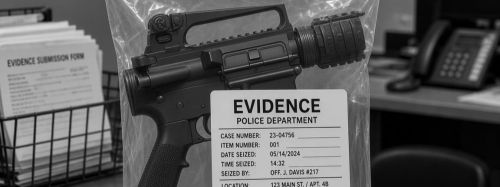
Gunshot residue, commonly abbreviated as GSR, is a type of forensic evidence that can appear in firearm-related criminal cases. Understanding what GSR is, how it is collected and analyzed, and its limitations is important for anyone facing gun charges in Massachusetts.
This post explains GSR in clear, straightforward language so non-lawyers can follow it. You will learn what GSR is, what it can (and cannot) prove, how defense attorneys challenge it in court, and why it matters in criminal defense.
What Exactly Is Gunshot Residue?
When a firearm is discharged, a small explosion occurs inside the gun. This explosion propels the bullet out of the barrel and also releases microscopic particles. These particles are known as gunshot residue (GSR).
GSR typically includes:
- Primer residue (from the chemical that ignites the gunpowder)
- Residue from the bullet or projectile itself
- Unburnt or partially burnt gunpowder particles
- Trace metals from the cartridge casing or gun barrel
These particles can land on the shooter’s hands, clothing, face, or nearby surfaces. They can also be transferred to other people or objects through contact.
What Can GSR Evidence Show?
Prosecutors sometimes use GSR analysis to try to connect a person to the discharge of a firearm. For example:
- The presence of GSR on a person’s hands or clothing may suggest they recently fired a gun or were very close to one when it was fired.
- The absence of GSR can sometimes help the defense argue that a person did not fire the weapon.
- Because GSR usually does not stay on a person’s skin for more than a few hours (often estimated at 4–6 hours under normal conditions), timing can become relevant.
GSR can also appear in cases involving discharging a firearm within 500 feet of a building, unlawful possession, or other firearm offenses.
Important Limitations of GSR Evidence
GSR analysis is not perfect, and it does not automatically prove guilt. Several important limitations exist:
- False positives are possible. Similar particles can come from other sources, such as fireworks, certain industrial tools, or brake pads.
- Transfer is common. A person can pick up GSR particles simply by touching a surface or another person who recently fired a gun (secondary transfer).
- Persistence is limited. GSR particles can be easily washed off, rubbed off, or lost through normal activity.
- Contamination risks exist. Samples can become contaminated during collection, packaging, or laboratory analysis.
- Not all ammunition produces the same particles. Modern “lead-free” or “non-toxic” primers may leave different chemical signatures that older testing methods were not designed to detect.
Because of these limitations, the mere presence of GSR does not automatically mean a person fired a gun, and the absence of GSR does not automatically mean they did not.
How GSR Is Collected and Analyzed
Police or crime scene technicians usually collect GSR by swabbing a person’s hands (especially the web of the hand between the thumb and index finger), face, or clothing. Sticky stubs or adhesive collectors are also commonly used.
In the laboratory, forensic scientists typically examine the particles under a scanning electron microscope with energy-dispersive X-ray spectrometry (SEM-EDS). This technique looks for characteristic combinations of elements (historically lead, barium, and antimony) that are associated with primer residue. The reliability of the results depends heavily on proper collection techniques, clean equipment, careful chain of custody, and the expertise of the analyst.
How to Challenge Gunshot Residue (GSR) Evidence in Court
Gunshot residue evidence is often presented by prosecutors as strong proof that a person recently fired a gun or was close to one when it was discharged. In reality, GSR evidence has significant limitations and can be challenged effectively in Massachusetts criminal cases.
An experienced defense attorney does not simply accept GSR results at face value. Instead, the attorney carefully examines how the evidence was collected, tested, and interpreted. Below are the main ways GSR evidence is commonly challenged in court.
1. Scientific Reliability and False Positives
GSR particles are not unique to firearms. Similar particles can come from fireworks, certain industrial tools or machinery, brake pads, and other automotive sources. A defense attorney may argue that the particles found are consistent with GSR but not characteristic of it, or that they could have originated from a non-firearm source. Laboratory reports should be scrutinized for the exact elemental composition and whether the particles meet accepted scientific standards for “characteristic” gunshot residue.
2. Secondary Transfer
GSR particles can easily move from one person or surface to another. A person can pick up residue by touching a firearm that was recently fired, shaking hands with or brushing against someone who fired a gun, or touching a vehicle, clothing, or other surface that contains residue. This is known as secondary (or tertiary) transfer. The presence of GSR on a person’s hands or clothing does not automatically mean that person pulled the trigger.
3. Contamination During Collection or Testing
Contamination can occur at the scene (dirty gloves, contaminated equipment, or improper handling), during packaging and transport, or in the laboratory (shared equipment, poor cleaning procedures, or cross-contamination between samples). Defense attorneys often request laboratory notes, quality-control records, and information about how the samples were handled. Any break in proper procedures can undermine the reliability of the results.
4. Improper Collection Methods
The way GSR is collected matters. Common issues include swabbing the wrong areas of the hands, failing to collect control samples, collecting samples too long after the alleged shooting, or using improper or contaminated collection materials. If police or technicians did not follow accepted protocols, the defense can argue that the results are unreliable or should be excluded.
5. Fourth Amendment / Search and Seizure Issues
GSR evidence is often collected from a person’s hands, clothing, or vehicle during a stop or arrest. If the underlying stop, search, or seizure violated the Fourth Amendment, the evidence may be suppressed. For example, police may open a car trunk without probable cause or consent and then swab items inside, or seize and test clothing without a warrant or valid exception. A successful motion to suppress can keep the GSR evidence out of trial entirely. This is why careful review of search and seizure issues is critical in firearm cases.
6. Timing and Persistence
GSR particles do not stay on a person’s skin or clothing indefinitely. Under normal conditions, they are often gone within 4–6 hours (and sometimes sooner with hand washing, sweating, or normal activity). If a significant amount of time passed between the alleged shooting and the collection of samples, the defense can argue that any residue found is unlikely to be connected to the incident — or that its absence is equally consistent with innocence.
7. Expert Qualifications and Methodology
The Commonwealth’s GSR analyst must be properly qualified, and the methods used must be scientifically valid. Defense counsel can challenge the expert’s credentials or experience, question whether the laboratory followed accepted standards, retain an independent expert to review the findings, or highlight limitations in the testing technology (especially with modern lead-free primers). In some cases, calling a defense expert witness is the most effective way to educate the judge or jury about the real weaknesses in GSR evidence.
8. Overall Context of the Case
Even when GSR particles are found, the Commonwealth must still prove every element of the charged crime beyond a reasonable doubt. GSR is rarely conclusive by itself. It must be viewed in light of all the other evidence — or the lack of other evidence. A strong defense often combines challenges to the GSR results with broader arguments about identification, intent, possession, or the circumstances of the stop and arrest.
GSR in the Broader Context of Firearm Cases
GSR evidence often appears alongside other firearm-related issues, such as:
In all of these cases, the Commonwealth must still prove every element of the charged crime beyond a reasonable doubt. GSR is only one piece of potential evidence — and it is rarely conclusive on its own.
Why Understanding GSR Matters
Forensic science can be powerful, but it is not infallible. Gunshot residue analysis has real value in some investigations, yet it also has well-documented weaknesses. Recognizing those weaknesses can make a meaningful difference in how a case is defended.
A thorough defense involves looking closely at how the evidence was collected, how it was tested, what the results actually mean, and whether the evidence was obtained lawfully. Early involvement of an experienced attorney helps ensure these issues are identified and raised at the right time.
IF YOU OR A LOVED ONE HAVE BEEN CHARGED WITH A GUN CRIME, AND YOU NEED AN EXPERIENCED CRIMINAL DEFENSE LAWYER WORKING ON YOUR SIDE TO PROTECT YOUR RIGHTS, PLEASE CONTACTCRIMINAL DEFENSE ATTORNEY WILLIAM J. BARABINO.
CALL 781-393-5900 TO LEARN MORE ABOUT YOUR AVAILABLE DEFENSES.
Related Posts