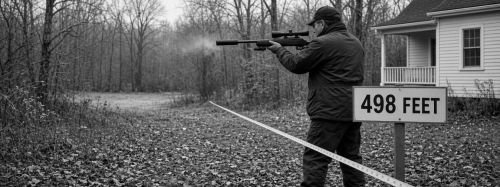
Massachusetts law restricts where a person may discharge a firearm. Under G.L. c. 269, § 12E, it is a crime to discharge a firearm within 500 feet of a dwelling or other building in use unless the owner or legal occupant has consented or a statutory exception applies. The offense is designed to protect people inside homes and other occupied structures from the risk of injury caused by nearby gunfire.
Although the maximum penalties are relatively modest compared with many other firearms offenses, a conviction can still result in jail time, a fine, a criminal record, and collateral consequences for licensing. This expanded guide explains the elements of the offense, how the 500-foot distance is measured, the available exceptions, and practical defense considerations.
The Statute: G.L. c. 269, § 12E
Section 12E(a) provides that whoever discharges a firearm (as defined in G.L. c. 140, § 121) within 500 feet of a dwelling or other building in use, except with the consent of the owner or legal occupant thereof, shall be punished by a fine of not less than $50 nor more than $100 or by imprisonment in a jail or house of correction for not more than three months, or both.
The statute covers pistols, handguns, rifles, and shotguns that meet the statutory definition of a firearm. Case law has confirmed that the offense can apply even when blank ammunition is used, and that the Commonwealth need not prove that the defendant knew he or she was within 500 feet of a building. In that sense the statute functions largely as a strict-liability or public-welfare offense focused on the act of discharge in a prohibited location.
What Counts as a “Dwelling or Other Building in Use”?
A “dwelling” is a place where people live—houses, apartments, condominiums, and similar residences. “Other building in use” is broader and can include offices, stores, schools, gyms, warehouses, and other structures that are used for human occupancy or activity. Courts have interpreted “in use” to protect potential occupants around the clock, not merely during business hours. A building need not be actively occupied at the precise moment of the discharge to fall within the statute.
How Is the 500-Foot Distance Measured?
The distance is measured in a straight line from the point where the firearm was discharged to the nearest part of the building’s structure. The Commonwealth bears the burden of proving beyond a reasonable doubt that the discharge occurred within that 500-foot radius. Accurate measurement—often supported by diagrams, maps, laser measurements, or testimony—can become a contested factual issue at trial.
Statutory Exceptions
The statute contains important exceptions. It does not apply to:
- The lawful defense of life or property;
- Any law enforcement officer acting in the discharge of official duties;
- The discharge of blank cartridges for theatrical, athletic, ceremonial, firing-squad, or similar purposes in accordance with G.L. c. 148, § 39;
- Discharges on the same property as an underground or indoor target/test range, an outdoor skeet/trap/target/test range, or a licensed shooting gallery, when done with the consent of the owner or legal occupant of the relevant land or building.
Consent of the owner or legal occupant of the dwelling or building in question is itself a complete defense. Even when an exception applies, the shooter remains subject to noise-control ordinances and certain other hunting or firearms restrictions.
Elements the Commonwealth Must Prove
To obtain a conviction, the Commonwealth must prove beyond a reasonable doubt that:
- The defendant discharged a weapon;
- The weapon met the legal definition of a firearm (or rifle or shotgun, as charged); and
- The discharge occurred within 500 feet of a dwelling or other building in use.
If the defense raises consent, the Commonwealth may also be required to prove the absence of consent. The discharge itself need not be intentional in the sense of a specific intent to violate the statute; causing the firearm to fire (intentionally or unintentionally) is sufficient under the prevailing interpretation.
Potential Defenses
Common defense issues include:
- Whether a firearm was actually discharged and whether the defendant was the person who discharged it;
- Whether the location of the discharge was truly within 500 feet of a qualifying building (measurement challenges);
- Whether the structure in question was a “dwelling” or “building in use”;
- Whether the owner or legal occupant consented;
- Whether a statutory exception (self-defense, law-enforcement duty, range use, blanks for ceremonial purposes, etc.) applies; and
- Evidentiary challenges to identification, ownership, or the reliability of the Commonwealth’s proof.
Because the distance element is geographic, careful investigation—photographs, measurements, maps, and witness interviews—can be decisive.
Practical Advice
Anyone who plans to discharge a firearm outdoors in Massachusetts should confirm that the location is more than 500 feet from any dwelling or building in use, or that clear consent has been obtained from the relevant owner or occupant. Target shooting, recreational shooting, and even the discharge of blanks can trigger the statute if the distance requirement is not met and no exception applies. Hunters and recreational shooters should also remain mindful of related restrictions under the hunting laws and local noise ordinances.
Frequently Asked Questions
Is ignorance of the distance a defense?
No. Courts have treated the offense as not requiring proof that the defendant knew he or she was within 500 feet of a building.
Do blanks count?
Yes. The discharge of blank cartridges can still violate the statute unless a specific exception (such as theatrical or ceremonial use under the applicable statute) applies.
What if I was defending myself?
The lawful defense of life or property is an express exception. Whether the facts support a self-defense or defense-of-property claim is a fact-intensive inquiry that should be evaluated with counsel.
Why Experienced Counsel Matters
Although § 12E carries relatively limited maximum penalties, a conviction still creates a criminal record and can affect firearms licensing and future opportunities. An attorney who regularly handles Massachusetts firearms cases can evaluate the measurement evidence, explore consent and statutory exceptions, challenge identification or the classification of the weapon, and work to resolve the case with the least long-term impact.
Contact Criminal Defense Attorney William J. Barabino
If you or a loved one has been charged with discharging a firearm within 500 feet of a building, or with any related firearms offense, early representation is important. The Law Office of William J. Barabino provides experienced, client-focused criminal defense in Massachusetts.
Call 781-393-5900 today for a confidential consultation.
Visit williambarabino.com for additional resources on gun charges and related offenses.
Related Blog Posts and Resources
You may also find these helpful:
Disclaimer: This article is for educational and informational purposes only and does not constitute legal advice. The law is subject to change, and the application of legal principles depends on the specific facts of each case. Reading this material does not create an attorney-client relationship. For advice regarding your particular situation, consult a qualified Massachusetts criminal defense attorney.