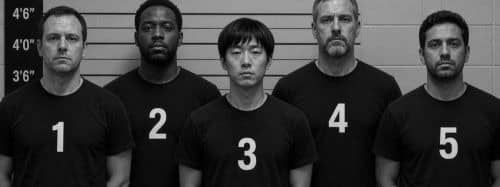
When you are arrested in Massachusetts, the police take a booking photograph, better known as a mug shot. It is not proof of guilt, and it is not part of your official criminal record. But it is also not automatically private. Whether anyone else can get it depends on the public records law, and how it is used in court depends on rules designed to keep it from unfairly suggesting guilt.
At a Glance: Mug Shots in Massachusetts
Not CORI
a booking photo alone is not criminal offender record information
Case by case
release under the public records law turns on the privacy exemption
Public officials
the SJC ordered booking photos of arrested police officers released
No negative inference
jurors may not hold it against you that police had your photo
The law: G.L. c. 4, § 7, cl. 26(a), (c); G.L. c. 6, § 167; G.L. c. 66, § 10
What a Booking Photo Is
A booking photo is taken at the police station as part of the booking process after an arrest. Police use it to identify the person arrested. Police also have photographs of people from other sources; the model jury instruction on identification mentions, for example, the Registry of Motor Vehicles.
Is a Mug Shot Part of Your Criminal Record?
Not by itself. Massachusetts’ Criminal Offender Record Information (CORI) law covers records that relate to the nature or disposition of a criminal charge, an arrest, a sentence, or release, and that were recorded in a criminal proceeding that was not dismissed before arraignment (G.L. c. 6, § 167). In Boston Globe Media Partners, LLC v. Department of Criminal Justice Information Services, 484 Mass. 279 (2020), the SJC held that booking photographs are not CORI, because a photo says nothing about the nature of the charge or its outcome. It is simply a product of booking. See What Is in a Massachusetts Criminal Record?.
Can the Public Get Your Mug Shot?
The Massachusetts public records law (G.L. c. 66, § 10) presumes that government records are public unless an exemption applies. Two exemptions in G.L. c. 4, § 7, clause Twenty-sixth matter most here:
- Exemption (a): records exempt by statute. In the Boston Globe case, the SJC held that the CORI law did not, by itself, make booking photos exempt.
- Exemption (c): records whose release would be an unwarranted invasion of personal privacy. Here the agency must weigh the public interest in disclosure against the privacy interest.
In that case, a newspaper requested booking photos and incident reports for police officers arrested for operating under the influence. The SJC ordered them released. The subjects were public officials, and the public interest in accountability outweighed their reduced privacy interest. The court said agencies deciding these requests should balance transparency, accountability, and public confidence against the risk that disclosure would unfairly cause adverse consequences to the accused.
The decision did not hold that every booking photo of every arrested person must be released on request. For a private citizen, the privacy balance may come out differently.
Where Your Booking Photo Can Show Up
Police files
Taken at booking and used to identify you, including in photo arrays shown to witnesses.
Public records requests
Not automatically secret. The agency weighs public interest against your privacy and the risk of unfair harm.
In court
If a witness picked your photo from an array, jurors can be told not to infer anything from the fact that police had it.
The law: G.L. c. 4, § 7, cl. 26(c); Boston Globe Media Partners v. DCJIS, 484 Mass. 279 (2020); Instruction 9.160
Mug Shots and Photographs in Court
If a witness identified you from a set of photographs, the jury may learn that police had your picture. Under the Massachusetts model jury instruction on eyewitness identification (Instruction 9.160), the judge should, on request, tell the jury that police have photographs of people from many sources, including the Registry of Motor Vehicles, and that jurors should not draw any negative inference from the fact that police had a photograph of the defendant.
The same instruction tells jurors to consider how a photo array was conducted: how many photos were shown, whether the defendant’s photo stood out, whether the person showing the photos knew who the suspect was, and whether anything said to the witness may have influenced the choice. See Eyewitness Identification and Expert Opinion.
Practical Guidance
- Do not assume your photo is private, or public. Release is decided request by request.
- If your photo has been posted online, a lawyer can review who released it, under what authority, and what options exist to get it taken down.
- If your case is resolved in your favor, ask about clearing your record. See expungement.
- If identification is at issue in your case, how police used photographs can be a key part of the defense.
Why a Lawyer Matters
An arrest can follow you in ways that have nothing to do with the outcome of the case. A lawyer can protect you in court, challenge identification evidence built on photographs, and help limit the damage an arrest record or booking photo can do. Attorney William J. Barabino has defended criminal cases for 23 years. Call 781-393-5900.
Related Topics
Disclaimer
This article is for general educational information about Massachusetts criminal law. It is not legal advice for your situation, and reading it does not create an attorney-client relationship. Laws change. For advice about a specific case, speak with a licensed Massachusetts attorney.