Massachusetts makes it a crime to copy recorded sound without the owner's consent in order to sell, rent, transport, or play the copies for profit. The law is G.L. c. 266, § 143A, and District Court Instruction 8.640 sets out what the Commonwealth must prove. The penalty depends on how many unlawful recordings are involved, and it ranges from a house of correction sentence to up to 5 years in state prison.
At a Glance: Unauthorized Transfer of Sound Recordings
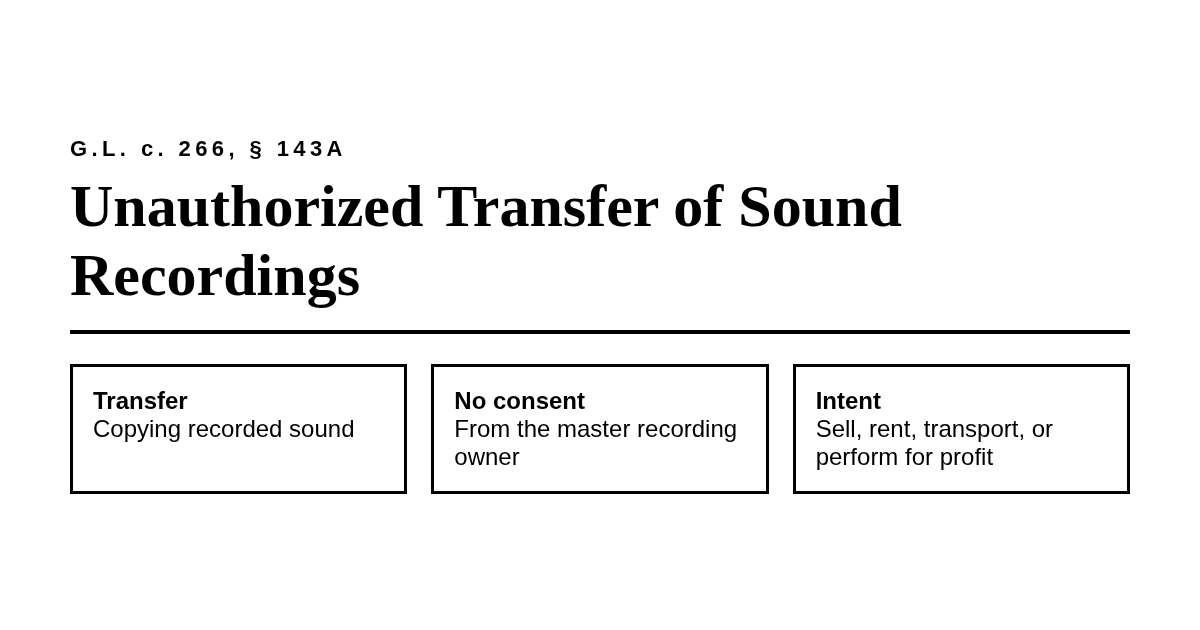
Transfer
copying recorded sound, directly or indirectly
Knowledge
you knew you were transferring the sound
No consent
the owner of the master recording did not agree
Intent
to sell, rent, transport, or perform for profit
The law: G.L. c. 266, §§ 143, 143A, 143D, 143E, 143H; District Court Instruction 8.640
What the Commonwealth Must Prove
Under Instruction 8.640, the Commonwealth must prove four elements beyond a reasonable doubt:
Transfer. You directly or indirectly transferred, or caused to be transferred, sounds recorded on a phonograph record, disc, wire, tape, film, videocassette, or other sound recording.
Knowledge. You knew you were transferring those sounds.
No consent. You did it without the consent of the owner of the master recording that the transferred sounds came from.
Intent. You intended to do one of the following, or to cause one of them to happen:
sell the copy;
rent the copy;
transport the copy;
play the copy in a public performance for profit.
Section 143A also punishes anyone who sells such a copy knowing that the sound was transferred without the owner's consent.
Who Counts as the Owner
Under G.L. c. 266, § 143, the "owner" is the person or entity that owns the master record, disc, tape, film, or other master device from which the transferred sounds or images were directly or indirectly derived. A "recorded device" includes any record, disc, wire, tape, audio or video cassette, film, or other medium, now known or later developed, along with any full or partial copy.
Penalties
G.L. c. 266, § 143E sets three penalty tiers based on the number of unlawful recordings:
Fewer than 100 sound recordings or fewer than 7 audiovisual recordings: up to 1 year in the house of correction, a fine of up to $25,000, or both.
100 to 999 sound recordings or 7 to 64 audiovisual recordings: up to 2 years in the house of correction, a fine of up to $100,000, or both.
1,000 or more sound recordings or 65 or more audiovisual recordings: up to 5 years in state prison, a fine of up to $250,000, or both.
When the evidence suggests at least 100 sound recordings or 7 audiovisual recordings, Instruction 8.640 directs the jury, if it convicts, to mark on the verdict slip which range the number of unlawful recordings falls into. That finding must rest on facts the Commonwealth proved beyond a reasonable doubt. It tells the judge which range of sentences the law permits.
Under G.L. c. 266, § 143H, the court may also order the forfeiture, destruction, or other disposition of the recordings and of the equipment used, or intended to be used, to make them.
Exceptions in the Statute
G.L. c. 266, § 143D says the law does not apply to:
a person lawfully entitled to use the sound or images for profit through public performance;
a transfer made as part of a radio or television broadcast;
a transfer made for archival preservation;
law enforcement officers using an audiovisual recording function during the lawful exercise of their duties.
Defenses
Consent: the owner of the master recording consented.
No commercial intent: there was no intent to sell, rent, transport, or perform for profit.
No knowledge: you did not know you were transferring the sounds, or, on a selling charge, you did not know the copy was unauthorized.
Statutory exception: the conduct falls under § 143D.
The count: the number of unlawful recordings controls the penalty tier, so the Commonwealth's count should be tested.
Why a Lawyer Matters
These cases often turn on paperwork and numbers: who owns the master recording, what consent existed, and how many copies the Commonwealth can actually prove. I have defended criminal cases for 23 years. If you have been charged with unauthorized transfer of sound recordings, call 781-393-5900.
This information is for general educational purposes only and not legal advice. Laws change. For advice about a specific case, speak with a licensed Massachusetts attorney.