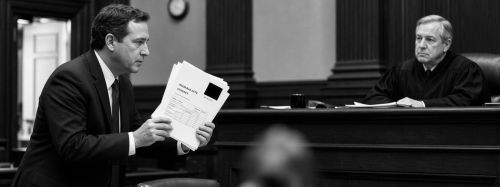
This post answers common questions about prior bad acts in Massachusetts criminal cases: what they are, when a prosecutor may use them, the test a judge applies, how the defense tries to keep them out, what the jury is told, and how this differs from using a prior conviction to attack a witness’s credibility.
At a Glance: Prior Bad Acts
Not propensity
other acts cannot be used to show bad character or that the defendant is the type to commit the crime
Limited purpose
they may come in only for a specific purpose, such as motive, intent, identity, or absence of mistake
Stricter test
excluded if the risk of unfair prejudice simply outweighs the probative value
Jury told how
the judge must tell jurors the one purpose the evidence may be used for
The law: Mass. G. Evid. § 404(b) (2026 ed.); District Court Model Jury Instruction 3.760; G.L. c. 233, § 21
What Are Prior Bad Acts?
When a defendant is not charged with committing any crime other than the charge or charges in the complaint, oftentimes there is mention of other acts allegedly done by the defendant separate from the crime in question. These “other acts” refer to a legal concept called “other” or “prior” bad acts.
No defense attorney wants accusations like these about a client in front of a judge or jury. So, every attorney works hard to investigate each bad act allegation and argue that the allegation should not come before any fact-finder.
The “act” does not have to be a crime, and it does not have to have led to a conviction. It can be an earlier arrest, an uncharged accusation, a threat, something that happened after the charged incident, or even lawful conduct the prosecution wants to cast in a bad light, such as owning weapons or writing violent lyrics. The Massachusetts Guide to Evidence treats all of these under the same rule.
How Could Prior Bad Acts Be Used in Court?
Evidence of other bad acts is not admissible in court to demonstrate the defendant’s bad character or propensity (inclination) to commit a crime charged.
But even though the fact-finder is informed that the act should not be used to prove guilt, it is hard for anyone to not be biased after hearing about any bad act. Again, that is why we fight hard to make sure that they don’t become part of your trial.
The government will often argue that a bad act is relevant for some other reason, for example, that it shows a relationship to something. If they are not too remote in time, other bad acts may be admissible in court to show:
- Motive
- Opportunity
- State of mind
- Intent
- Preparation
- Plan
- Pattern of operation
- Common scheme
- Relationship between a defendant and a victim
- Knowledge
- Identity
- Absence of mistake
- Lack of accident
Courts instruct jurors to recognize when evidence of other bad acts are utilized in a confusing or exaggerated manner. Using other bad acts in either of these ways is not allowed in court.
That list is not a menu the prosecutor can order from freely. The purpose has to fit the facts of the case, and the judge has to decide whether it does.
The Massachusetts Rule: Section 404(b) of the Guide to Evidence
Section 404(b) of the Massachusetts Guide to Evidence (2026 edition) sets out the rule in two parts. First, evidence of a crime, wrong, or other act “is not admissible to prove a person’s character in order to show that on a particular occasion the person acted in accordance with the character.” Second, the evidence “may be admissible for another purpose, such as proving motive, opportunity, intent, preparation, plan, knowledge, identity, absence of mistake, or lack of accident.”
Even when the prosecution has a proper purpose, the evidence still must pass a balancing test. Under Section 404(b)(2), evidence of other bad acts “is inadmissible where its probative value is outweighed by the risk of unfair prejudice to the defendant, even if not substantially outweighed by that risk.” That is stricter than the general rule for other evidence in Section 403, which excludes evidence only when unfair prejudice substantially outweighs its value. The Guide explains that the stricter test exists because of the inherent prejudice that comes with bad act evidence.
The notes to Section 404 and to the model jury instruction describe several other requirements:
- The act must be provable. The judge must be satisfied that a reasonable jury could find that the other act actually took place.
- There must be a logical connection. The evidence must be probative of a fact actually at issue, with a logical relationship between the other act and the crime charged.
- It cannot be too remote in time. There is no bright-line cutoff; the question is how closely the old act connects to the charge.
- The purpose must be precise. The prosecutor offering the evidence should identify the exact non-propensity purpose, and the judge should explain on the record how the evidence is relevant for that purpose and weigh its value against the risk of prejudice.
- Identity requires something distinctive. When other acts are offered to prove who committed the crime, the similarities must be truly distinctive, not just the same type of offense.
- Acquittals are off limits. Under Section 404(b)(2), evidence of an act is not admissible against a defendant who was prosecuted for that act and acquitted.
Keeping Bad Act Evidence Out: Motions in Limine
The best time to fight bad act evidence is before the jury ever hears it. The notes to the District Court’s model instruction say the issue typically should be addressed before trial in a motion in limine, and that the judge should ask the Commonwealth the exact purpose for which the evidence is being offered.
A defense motion in limine asks the judge to rule in advance that the other act stays out, or to limit how much of it comes in. The defense can argue that the act cannot be proven, that the claimed purpose does not really fit the facts, that the act is too old, or that the prejudice outweighs any value. Even if the judge allows part of the evidence, the motion can narrow the details the jury hears. For more on how pretrial rulings shape a trial, see our article on what a jury sees.
If a witness mentions a bad act the judge has already excluded, the defense should object right away and ask the judge to strike it and tell the jury to disregard it. See our article on excluded and stricken evidence.
The Limiting Instruction: Model Jury Instruction 3.760
When bad act evidence is admitted, the jury must be told how it may and may not be used. In the District Court, the model instruction is Instruction 3.760, Other Bad Acts by Defendant (revised February 2024). Its notes say it should be given at the time the evidence is admitted and again in the final charge.
The instruction reminds jurors that the defendant is not charged with any crime other than the charges in the complaint. It tells them they may not take the testimony as proof that the defendant committed the crime charged, nor as proof that the defendant has a bad character or a propensity to commit crimes. The judge then names the specific purpose the jury may consider it for. The instruction ends:
“You may not consider this evidence for any other purpose. Specifically, you may not use it to conclude that if the defendant committed the other act(s), they must also have committed the offense(s) alleged in the complaint.”
The 2024 revision added an important point: the judge should list only the purpose or purposes that apply to the case, not read the jury the whole list. The notes explain that simply instructing on every permissible purpose is generally insufficient guidance.
If the evidence should never have come in at all, a different part of Instruction 3.760 applies. The judge tells the jury that the testimony has been struck from the record, that they must disregard it entirely, and that the verdict must rest on evidence related to the charges in the complaint. And if the defendant denies being the person who committed the other act, the notes say the identification instruction is required on request, even if identity is not an issue for the charge on trial.
Prior Convictions Used to Impeach Are Different
Note that a witness’s past can also come up when the other side attacks the witness’s credibility, but different rules apply. In general, specific instances of misconduct showing a witness to be untruthful are not admissible to attack the witness’s credibility. Mass. G. Evid. § 608(b).
The main exception is a prior conviction. Under G.L. c. 233, § 21, a witness’s conviction of a crime may be shown to affect credibility, subject to time limits:
- A misdemeanor conviction cannot be used after five years from sentencing.
- A felony conviction without a state prison sentence cannot be used after ten years from conviction or sentencing.
- A felony with a state prison sentence cannot be used after ten years from the end of the minimum term.
- A traffic violation with only a fine cannot be used at all, unless the witness has another conviction within five years of testifying.
The misdemeanor and felony limits do not apply if the witness has been convicted of another crime within five years (for a misdemeanor) or ten years (for a felony) of testifying. Under Section 609 of the Guide, the conviction is shown by the court record, without reference to the sentence.
The difference matters. A prior bad act under Section 404(b) is offered as evidence on an issue in the case, such as intent or identity, and it need not be a conviction. A prior conviction under § 21 is offered only to suggest that the witness is less believable. If you are the defendant and you testify, the prosecutor may ask to use an old conviction this way, and the judge has discretion to keep it out. The Guide notes that when the old conviction is similar to the current charge, that similarity weighs in favor of keeping it out. See our article on whether you have to testify, and on how prior convictions can also raise penalties, What Is a Subsequent Offense?.
Frequently Asked Questions
Can the prosecutor tell the jury about other things I have been accused of?
Not to show that you are the kind of person who commits crimes. The Commonwealth must identify a specific, legitimate purpose, the judge must find that the probative value is not outweighed by the risk of unfair prejudice, and the jury must be told how the evidence may be used.
Does the other act have to be a conviction?
No. It can be an uncharged act. But the judge must be satisfied that a reasonable jury could find the act took place.
What if I was found not guilty of the other act?
Under Section 404(b)(2) of the Guide, evidence of an act is not admissible against a defendant who was prosecuted for that act and acquitted.
Can my record be used against me if I testify?
Possibly. A prior conviction may be used to impeach your credibility if it falls within the time limits of G.L. c. 233, § 21, and the judge decides to allow it. Arrests and charges that did not end in a conviction generally cannot be used that way.
Can the defense use the alleged victim’s bad acts?
Sometimes. The notes to Instruction 3.760 say the test is the same when the defendant is the one offering other bad acts of the alleged victim. In self-defense cases, Section 404(a) of the Guide also allows evidence of the alleged victim’s violence in certain situations, such as when it is disputed who started the fight.
Talk to a Massachusetts Defense Lawyer About Your Case
Bad act evidence can decide a trial, and the most important work usually happens before the jury is sworn. If you or a loved one have been charged with a crime or have a legal question on prior bad acts, contact the Law Office of William J. Barabino in Medford. Attorney Barabino represents clients in criminal defense matters throughout Greater Boston.
Call 781-393-5900 to learn more about your available defenses.
Related Articles
Disclaimer
This article is for general educational purposes only and is not legal advice. Massachusetts statutes, court rules, model jury instructions, and court decisions can change, and every case turns on its own facts. Reading this page does not create an attorney-client relationship. If you are facing a criminal charge, consult a licensed Massachusetts criminal defense attorney about your situation.