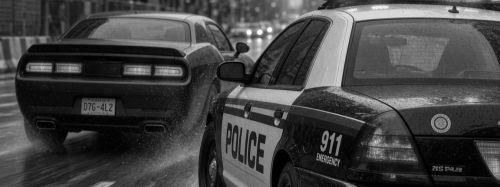
You’ve been charged with road racing, or your son or daughter has. Maybe two cars took off fast from a light, or friends pushed each other to see who was quicker. A racing charge can cost you your license, so it makes sense to be worried. Here’s what the law actually says, in plain words.
This post covers what the law says, how people end up charged, what the Commonwealth has to prove, the penalties and license loss, how road racing differs from drag racing and negligent operation, and where a defense comes from.
What the Road Racing Law Says
It’s a crime to drive in a race or on a bet in a public place, or to speed to set a record.
The law is part of G.L. c. 90, § 24(2)(a). It covers whoever, “upon any way or in any place to which the public has a right of access, or any place to which members of the public have access as invitees or licensees,” operates a motor vehicle “upon a bet or wager or in a race,” or “whoever operates a motor vehicle for the purpose of making a record and thereby violates any provision of section seventeen or any regulation under section eighteen.”
So the law covers three things:
- Driving on a bet or wager. A wager is just another word for a bet.
- Driving in a race.
- Speeding to set a record. This part also requires breaking the speed laws in G.L. c. 90, § 17 or speed rules set under § 18.
The speed-law requirement is written into the record-setting part. The bet and race parts don’t mention it.
What Counts as a “Race”
The statute doesn’t define “race,” but the District Court’s model jury instruction does.
The District Court model jury instruction on road racing (Instruction 5.640) says: “A motor vehicle race is a competition between the drivers of two or more vehicles to excel in the rate of acceleration or in the speed of their respective vehicles.” It adds that “direct evidence of an agreement to race is not required if the circumstances support an inference that the defendant entered into an agreement, either express or implied, to engage in a race.” In plain words, the drivers don’t have to say “let’s race.” An agreement can be shown by what happened.
The same instruction says “record” has its ordinary meaning: “the best performance, surpassing all others involved in that event.”
Where It Has to Happen
The law applies on public roads and in other places the public can go.
It covers “any way,” meaning a public road, and “any place to which the public has a right of access,” or where the public has access “as invitees or licensees.” In plain words, it isn’t limited to public streets. Read more about public ways and what counts as a motor vehicle.
How People End Up Facing This Charge
Most racing charges come from a few seconds of showing off on a public road.
- Two drivers rev their engines at a red light and speed off side by side when it turns green. That can look like “a competition between the drivers of two or more vehicles to excel in the rate of acceleration.”
- Friends bet money on who can get to the next town first. That’s driving “upon a bet or wager.”
- A group meets in a store parking lot at night to see whose car is fastest. A lot open to the public can be a place where the public has “access as invitees or licensees.”
- A driver tries to beat a personal best time on a stretch of highway and goes over the speed limit. That’s driving “for the purpose of making a record” and breaking the speed law.
- A driver keeps speeding up every time another car tries to pass, and the other driver does the same. An agreement to race can be shown by the circumstances, without words.
- A teenager with a junior license is stopped after racing a friend’s car. The same law applies, and drag racing has special rules for junior operators, explained below.
What the Commonwealth Must Prove
The Commonwealth (the state, through the prosecutor) has to prove three things beyond a reasonable doubt.
- You operated a motor vehicle.
- It was on a way, or in a place where the public has a right of access or access as invitees or licensees.
- You drove upon a bet or wager, or in a race, or you broke the speed laws to set a record.
An element is one required piece of the crime. If the Commonwealth can’t prove any one of them, you can’t be convicted. Read more about proof beyond a reasonable doubt.
Penalties and License Loss
Road racing carries jail or a fine, and your license can be revoked.
- Fine or jail: a fine of $20 to $200, or 2 weeks to 2 years of imprisonment, or both.
- License revocation: under § 24(2)(b), the court must report the conviction to the Registrar. The Registrar may revoke your license, and must unless the court recommends otherwise. An appeal doesn’t stop the revocation.
- Registration: the Registrar may also revoke the registration of vehicles you own or control.
- Getting your license back: under § 24(2)(c), the Registrar may issue a new license after an investigation or hearing, or if the case ends in your favor.
Under G.L. c. 274, § 1, “a crime punishable by death or imprisonment in the state prison is a felony. All other crimes are misdemeanors.” Road racing has no state prison term, so it’s a misdemeanor. Read more about license suspension and revocation.
How This Is Different From Drag Racing
Drag racing is a separate crime with its own wording, penalties, and license rules.
- What it covers. Drag racing, G.L. c. 90, § 17B, covers operating a vehicle, or an owner letting it be operated, so the driver “accelerates at a high rate of speed in competition with another operator, whether or not there is an agreement to race, causing increased noise from skidding tires and amplified noise from racing engines.”
- Penalties. Up to 2½ years in the house of correction or a fine of up to $1,000. The Registrar must suspend the license for at least 30 days for a first offense and at least 180 days for a later one.
- Junior operators. A driver with a junior license or learner’s permit faces a fine of at least $250 and a 1-year suspension for a first offense, and at least $500 and a 3-year suspension for a later one, plus a road rage program. For these drivers, drag racing is a civil motor vehicle infraction, not a crime, because their penalties don’t include jail (G.L. c. 90C, § 1). The model jury instruction says the same.
How This Is Different From Negligent Operation
Road racing and negligent operation are in the same paragraph of § 24(2)(a), but they cover different things.
- Road racing is about driving in a race, on a bet, or to set a record. It doesn’t require proof that you drove negligently.
- Negligent operation is about driving “negligently so that the lives or safety of the public might be endangered.” It doesn’t require a race or a bet.
- Same penalty. Both carry a fine of $20 to $200, 2 weeks to 2 years, or both, and the same license-revocation rules.
Related Charges
Racing can lead to other driving charges, depending on what happened.
- Negligent operation (G.L. c. 90, § 24(2)(a)): driving in a way that endangers the public, with or without a race.
- Drag racing (G.L. c. 90, § 17B): high-speed acceleration in competition with another driver, with or without an agreement.
- Speeding (G.L. c. 90, § 17): driving faster than is “reasonable and proper,” a civil infraction when charged alone.
- Motor vehicle homicide (G.L. c. 90, § 24G): a death caused by reckless driving, or by impaired driving that’s reckless or negligent.
Where a Defense Comes From
A defense starts with each element and the proof behind it.
- Was it a race? The Commonwealth must show a competition between two or more drivers.
- Any agreement? An agreement to race can be inferred, but only if the circumstances support it.
- Where it happened. Was it a way or a place open to the public?
- Record-setting. For that part, the Commonwealth must also prove a speed-law violation.
- Identity. Were you the driver?
Frequently Asked Questions
Do the drivers have to agree to race?
Not in words. Under the model jury instruction, an agreement can be inferred from the circumstances, and it can be “express or implied.”
Will I lose my license for road racing?
The Registrar must revoke your license after a conviction unless the court recommends otherwise, and an appeal doesn’t stop it.
Is road racing a felony?
No. It has no state prison term, so under G.L. c. 274, § 1 it’s a misdemeanor.
Facing a Road Racing Charge? Talk to a Lawyer
A racing charge turns on what the drivers did, where it happened, and what can be proved about an agreement. You don’t have to face it alone. The Law Office of William J. Barabino in Medford has over 23 years of experience in Massachusetts criminal defense and represents clients throughout Greater Boston.
Call 781-393-5900 to talk about your charge and your options.
Related Articles
Disclaimer
This article is for general educational information about Massachusetts criminal law. It is not legal advice for your situation, and reading it does not create an attorney-client relationship. Laws change. For advice about a specific case, speak with a licensed Massachusetts attorney.