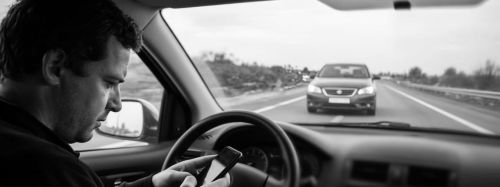
You got a ticket for using your phone while driving, or your teenager did. Maybe you were just glancing at a text or holding the phone at a red light. You probably want to know what the law really says and what it costs. Here it is in plain words.
This post covers what the hands-free law says, the rules for drivers under 18, how people end up with a ticket, the fines and insurance rules, when phone use becomes a crime, and where a defense comes from.
What the Hands-Free Law Says
In Massachusetts, a driver can’t hold a phone or other mobile device, and can use one only in hands-free mode.
The law is G.L. c. 90, § 13B(a). It sets three rules for any driver:
- “No operator of a motor vehicle shall hold a mobile electronic device.”
- No operator “shall use a mobile electronic device unless the device is being used in hands-free mode.”
- No operator “shall read or view text, images or video displayed on a mobile electronic device.”
There’s one exception for maps. You may view a navigation map on a device that’s “mounted on or affixed to a vehicle’s windshield, dashboard or center console” in a way that doesn’t get in the way of driving.
Key Words in the Law
The law’s key terms are defined in G.L. c. 90, § 1.
- Mobile electronic device: any hand-held or portable electronic equipment that can send data between 2 or more people. That includes a phone, a texting device, a laptop, a personal digital assistant, a device that plays video games or videos, and a camera that sends photos. It doesn’t include audio equipment, or navigation or emergency equipment installed in the car.
- Hands-free mode: using a device to talk or listen “without touching or holding the device.” The law allows “a single tap or swipe to activate, deactivate or initiate the hands-free mode feature.”
- Operating: under § 13B, you’re not considered to be operating if the car is “stationary and not located in a part of the public way intended for travel by a motor vehicle or bicycle.” In plain words, a car parked off the travel lanes doesn’t count. A car stopped in traffic is still in the travel lanes.
A separate law, G.L. c. 90, § 13, says a driver may use a mobile electronic device, except as limited by §§ 8M, 12A, and 13B, “as long as 1 hand remains on the steering wheel at all times.”
Special Rules for Drivers Under 18
Drivers under 18 can’t use a phone at all while driving, even hands-free.
G.L. c. 90, § 8M says “no person under 18 years of age shall hold in their hand or use a mobile telephone, hands-free mobile telephone or mobile electronic device while operating a motor vehicle on any public way.” A “junior operator” is a driver under 18. Penalties under § 8M:
- First offense: a $100 fine and a 60-day license or permit suspension. Your license won’t be reinstated until you also finish a program chosen by the Registrar.
- Second offense: a $250 fine and a 180-day suspension.
- Third or later offense: a $500 fine and a 1-year suspension.
How People End Up With a Ticket
Most hands-free tickets come from quick, everyday habits behind the wheel.
- Someone holds the phone to their ear for a call. The law says no driver “shall hold a mobile electronic device.”
- Someone reads a text at a red light. A car stopped in a travel lane is still being operated under § 13B, and the law bars reading text on a device.
- Someone types a reply or scrolls social media while driving. That’s using the device, not in hands-free mode.
- Someone holds the phone in their hand to follow a map. The map exception applies only to a device that’s mounted on the windshield, dashboard, or center console.
- Someone watches a video on a phone propped on the seat. The law bars viewing “video displayed on a mobile electronic device.”
- A 17-year-old driver takes a call through the car’s speaker. Under § 8M, drivers under 18 can’t use even a hands-free phone.
Fines, Training, and Insurance
Breaking the hands-free law costs a fine, and repeat offenses add a required program and can raise your insurance.
Under § 13B(d), the fines are:
- First offense: $100.
- Second offense: $250.
- Third or later offense: $500.
For a second or later offense under § 13B or § 8M, you must also complete a program chosen by the Registrar of Motor Vehicles that “encourages a change in driver behavior and attitude about distracted driving.” The law also says nothing in that part authorizes seizing or forfeiting your phone.
Under § 13B(e), a first or second offense is not a “surchargeable incident” under your auto insurance. A surchargeable incident is an event that can raise your insurance premium. A third or later offense is surchargeable. The same rule applies under § 8M.
Is Texting and Driving a Crime?
Usually no. A hands-free violation is a civil motor vehicle infraction, but it can become part of a criminal charge if it causes harm.
G.L. c. 90C, § 1 defines a “civil motor vehicle infraction” as an automobile law violation “for which the maximum penalty does not provide for imprisonment.” Section 13B has fines only, so a violation is a civil infraction. That definition has exceptions, including “any automobile law violation committed by a juvenile who does not hold a valid operator’s license.”
Phone use can lead to a criminal charge under G.L. c. 90, § 24(2)(a). That law punishes whoever, while driving in violation of § 8M, 12A, or 13B, “such violation proved beyond a reasonable doubt, is the proximate cause of injury to any other person, vehicle or property by operating said motor vehicle negligently so that the lives or safety of the public might be endangered.” “Proximate cause” means the violation directly led to the injury or damage. The penalty is a fine of $20 to $200, 2 weeks to 2 years of imprisonment, or both. Read more about the difference between civil infractions, misdemeanors, and felonies.
How This Is Different From Negligent Operation
A hands-free ticket is about holding or using a device. Negligent operation is about how you drove.
- Hands-free violation (§ 13B): holding a device, using it other than hands-free, or reading or viewing it while driving. It’s a civil infraction with fines.
- Negligent operation (§ 24(2)(a)): operating “negligently so that the lives or safety of the public might be endangered.” It’s a crime and doesn’t require any phone use.
- Phone use that causes injury (§ 24(2)(a)): combines the two. The Commonwealth must prove the § 13B (or § 8M or § 12A) violation beyond a reasonable doubt, negligent operation, and that it was the proximate cause of injury to a person, vehicle, or property.
Related Charges
Phone use while driving can come up alongside other driving charges.
- Negligent operation (G.L. c. 90, § 24(2)(a)): driving in a way that endangers the public, with or without a phone.
- Public transit operators (G.L. c. 90, § 12A): bars phone use by drivers of buses, trains, school buses, and ferries, with a $500 fine.
- Leaving the scene of property damage (G.L. c. 90, § 24(2)(a)): driving away after a crash that damages property without stopping and giving your information.
- Motor vehicle homicide (G.L. c. 90, § 24G): a death caused by reckless driving, or by impaired driving that’s reckless or negligent.
Where a Defense Comes From
A defense starts with the exact words of § 13B and the facts of the stop.
- Emergency. Under § 13B(b), using a device “in response to an emergency” is an affirmative defense, meaning a defense you raise with evidence. An emergency means you needed to report a disabled vehicle, a need for medical help, a need for police, fire, or other emergency services for safety, or a disabled vehicle or crash on the road. Section 8M has a similar emergency defense for drivers under 18.
- Not operating. You weren’t operating if the car was stationary and not in a part of the public way meant for travel.
- Hands-free or mounted map. Hands-free use is allowed, including a single tap or swipe, and so is viewing a map on a mounted device.
- Not a mobile electronic device. Audio equipment and installed navigation or emergency equipment aren’t covered.
- First responders. Under § 13B(c), the law doesn’t apply to public safety personnel or emergency first responders using a device in an emergency services vehicle while on duty.
Frequently Asked Questions
Can I use my phone at a red light in Massachusetts?
Not by holding it or reading it. Section 13B treats you as operating unless the car is stationary and off the part of the road meant for travel. A car stopped at a light is in the travel lanes.
Can I use my phone for GPS?
Yes, if it’s mounted on the windshield, dashboard, or center console in a way that doesn’t interfere with driving. You can tap or swipe once to start hands-free mode.
Will a texting ticket raise my insurance?
Not for a first or second offense. Under § 13B(e), a third or later offense is a surchargeable incident.
Is texting and driving a criminal offense?
Usually not. It’s a civil infraction with fines. It becomes part of a criminal charge under § 24(2)(a) if the violation, proved beyond a reasonable doubt, is the proximate cause of injury while you were driving negligently.
Facing a Texting and Driving Ticket or Charge? Talk to a Lawyer
A hands-free ticket may seem small, but repeat offenses bring training and insurance surcharges, and a crash can turn it into a criminal case. The Law Office of William J. Barabino in Medford has over 23 years of experience in Massachusetts criminal defense and represents clients throughout Greater Boston.
Call 781-393-5900 to talk about your ticket or charge and your options.
Related Articles
Disclaimer
This article is for general educational information about Massachusetts law. It is not legal advice for your situation, and reading it does not create an attorney-client relationship. Laws change. For advice about a specific case, speak with a licensed Massachusetts attorney.