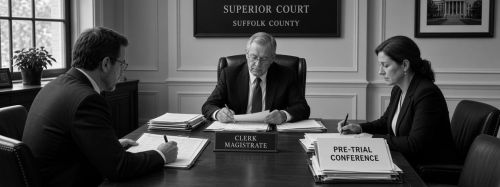
After arraignment, most Massachusetts criminal cases do not jump straight to a jury trial. The next major court milestone for many District Court defendants is what people commonly call a pre-trial conference — often shortened to “PTC.” It is easy to confuse that date with the trial itself. It is not the trial. It is a scheduled checkpoint where the prosecutor, defense counsel, and the court take stock of discovery, possible disposition talks, motions, and what the next event should be.
This guide explains what a pre-trial conference is in Massachusetts District Court practice, when it typically happens after arraignment, what gets discussed, what defendants should expect, the roles of the prosecutor, defense lawyer, and judge or clerk, and common outcomes. It sits in the process stack after arrest, arraignment, and bail. For those earlier steps, see What Happens When You Get Arrested, What Happens at an Arraignment, and Bail Basics. This post does not re-argue bail factors or walk through a full plea colloquy — those topics have their own pages.
What a pre-trial conference is — and what it is not
In everyday court language, “pre-trial conference” usually means the court date set after arraignment so counsel can conference the case and report to the court. Under Massachusetts criminal procedure, counsel are expected to confer, often complete a Pretrial Conference Report, and appear for a pretrial hearing on the results of that conference. Defendants may see the date labeled PTC, pretrial, or another short session name. The label matters less than the purpose.
A PTC is not the trial. Witnesses are not lined up to testify about the alleged crime the way they would at trial. You are not opening a case to a jury. The hearing is typically short and counsel-driven. The court is checking status: Has discovery been provided or ordered? Are there disputed discovery issues? Is either side ready to discuss a plea, admission, or other disposition? What is the next date — compliance, motion hearing, trial assignment, or something else?
People also confuse a PTC with a full evidentiary motion hearing or a plea hearing. Those can happen on or near a pretrial date in some cases, but they are different events with different preparation.
When the pre-trial conference typically happens after arraignment
At arraignment, the court starts the case, addresses release, and sets a schedule. In District Court practice, that schedule ordinarily includes a date for the parties to conference and appear for a pretrial hearing. Timing varies by courthouse calendar, charge complexity, custody status, and whether discovery is already moving. Some cases return relatively soon; others are set further out so reports, body-worn camera footage, lab results, or other materials can catch up.
If you are still hiring counsel — or switching lawyers — between arraignment and the PTC, tell the court through counsel or as directed. Courts know people need time to retain a lawyer. Do not assume missing counsel means you should ignore the date. Confirm appearance requirements with your lawyer and the notice you received.
The PTC is also not a free pass on conditions of release. Bail, stay-away orders, GPS, or other conditions set earlier generally remain in force unless the court changes them. See Conditions of Release.
What gets discussed at a pre-trial conference
Most PTCs revolve around practical status topics:
- Discovery status. Has the Commonwealth turned over police reports, videos, 911 recordings, lab results, and other materials required by rule or order? Are items still outstanding? Defense counsel may also address reciprocal discovery when it applies.
- Discovery disputes and motions. If something was not produced, the parties may ask the court to order production, set a compliance date, or schedule further motion practice. Broader discovery updates are covered in New Discovery Rules.
- Plea and disposition discussions — at a high level. Counsel may report whether talks are ongoing, whether more discovery is needed before advice is meaningful, or whether the defense is preparing for trial. A plea is not required at the PTC. See The District Court Plea and Continued Without a Finding in Massachusetts.
- Next event and trial path. The court may set a compliance and election date, a motion date, a trial assignment date, or another return. If discovery is complete and no disposition is entered, the case may move toward jury election or waiver and trial scheduling under the applicable District Court rules.
- Compliance with conditions. Sessions sometimes confirm whether the defendant has followed release conditions or reporting requirements. Serious alleged violations are usually handled as their own issues.
What defendants should expect in the courtroom
Most PTCs feel nothing like television trials. You typically wait in the gallery until the clerk calls your name or docket. When called, you stand with your lawyer. Your attorney usually does the talking: reporting discovery status, requesting orders, noting disposition posture, and proposing a next date. You may be asked to confirm your name, acknowledge a date, or answer a narrow question from the judge. Lengthy testimony about “what happened” is not the usual point of the hearing.
The appearance can be brief — sometimes only a few minutes once the case is reached — even if you waited longer for the call. That does not mean the date is unimportant. Orders entered on the record, discovery deadlines, and the next court date are binding. If the court tells you a return date in open court, treat that as your notice unless your lawyer says otherwise.
Dress and demeanor still matter. Arrive early, silence your phone, and follow security rules. Practical tips: How to Dress for Court.
Roles of the prosecutor, defense counsel, and the court
Prosecutor (Assistant District Attorney). The ADA represents the Commonwealth. At the PTC, the prosecutor reports on discovery production, responds to defense requests, and may state a position on disposition if talks have progressed.
Defense counsel. Your lawyer reviews what has been produced, identifies what is missing, advises whether it is too early to plead, and protects your rights on the record. Bring questions beforehand so decisions are not made under hallway pressure.
Judge and clerk. The clerk calls the list and helps manage paperwork and dates. The judge reviews the Pretrial Conference Report when one is submitted, rules on disputed discovery issues as appropriate, may address a tendered plea or other disposition if offered, and sets the next event. The court is not trying the full case that day unless a separate hearing is actually before it.
Common outcomes after a pre-trial conference
Outcomes vary, but these are among the most common:
- Next date set. The case is continued to a compliance and election hearing, a further pretrial date, a motion hearing, trial assignment, or another scheduled event. “Compliance and election” generally focuses on whether discovery orders were met and, when discovery issues are resolved, the defendant’s jury election or waiver and trial scheduling.
- Discovery orders. The court may order outstanding materials produced by a date certain or note agreements from the Pretrial Conference Report. Remedies for noncompliance are case-specific.
- Motion schedule. Additional motions may be set for a later hearing. Calendar filing and hearing dates carefully with counsel.
- Plea or CWOF discussion starts or continues. Sometimes a disposition is tendered at the pretrial hearing; often it is not. Deep plea mechanics and CWOF consequences belong on the plea and CWOF pages linked above.
- Case moves toward trial posture. If no disposition is entered and discovery is far enough along, the path toward trial dates or assignment becomes clearer. That still is not the trial itself.
For a broader look at early resolutions, see Dispositions After Arraignment.
Practical tips before your PTC
- Meet or speak with counsel beforehand. Ask what discovery is in, what is missing, whether a plea conversation is realistic yet, and whether your presence is required.
- Write down questions. Notes about work schedules, treatment progress, stay-away logistics, or documents you can gather help counsel advise you without scrambling.
- Confirm attendance requirements. Follow the court’s order and your lawyer’s instruction. Missing a required date can lead to a default and a warrant.
- Bring proof of compliance if relevant. Program letters, treatment attendance, or similar documents are often more useful before the hearing than after.
- Do not narrate the incident on the record unless counsel directs you. Fact-intensive explanations belong in privileged conversations with your lawyer first.
- Track the next date yourself. Put the return date on your calendar immediately and ask counsel what that date is for.
Frequently asked questions
Is the pre-trial conference my trial date?
No. A PTC is a status and planning date after arraignment. Trial, if the case goes that far, is a separate event.
Do I have to decide on a plea at the PTC?
Not necessarily. Many defendants are not ready because discovery is incomplete or counsel needs more time to advise. See The District Court Plea when you are ready to understand how pleas work.
What if I do not have a lawyer yet?
Appear as required and tell the court you are seeking counsel, or apply for appointed counsel if you qualify. Do not ignore the date.
Will I have to testify?
Usually not about the facts of the alleged offense. The hearing is typically short and handled by counsel. If a separate evidentiary hearing or plea is actually occurring that day, your lawyer will prepare you.
What is a compliance and election date?
When discovery remains outstanding after the pretrial hearing, the court may schedule a later hearing focused on whether discovery orders were met and, once those issues are resolved, on jury election or waiver and trial scheduling. Your lawyer will explain your particular next date.
Can bail or conditions change at the PTC?
Sometimes release issues are revisited if circumstances change, but ordinary PTC business is discovery, disposition posture, and scheduling. See Determining Bail and Conditions of Release.
Questions about a pre-trial conference in Massachusetts?
IF YOU OR A LOVED ONE HAVE BEEN CHARGED WITH A CRIME, AND YOU NEED AN EXPERIENCED CRIMINAL DEFENSE LAWYER WORKING ON YOUR SIDE TO PROTECT YOUR RIGHTS, PLEASE CONTACT CRIMINAL DEFENSE ATTORNEY WILLIAM J. BARABINO AT 781-393-5900.
The Law Office of William J. Barabino represents clients in Massachusetts District Court, Juvenile Court, and Superior Court matters from Medford and throughout the Commonwealth. Call 781-393-5900 to discuss your next court date, discovery status, and how to prepare for a pre-trial conference.
Related Articles
Disclaimer
This article is for general educational purposes only and is not legal advice. Pre-trial conference and pretrial hearing practices can vary by courthouse, session, charge, custody status, and the facts of the case. Massachusetts District/Municipal Courts Rules of Criminal Procedure and Mass. R. Crim. P. 11 provide the general framework discussed here; individual standing practices and calendars differ. Reading this page does not create an attorney-client relationship. If you have a pending case, speak with a licensed Massachusetts criminal defense attorney about your situation.