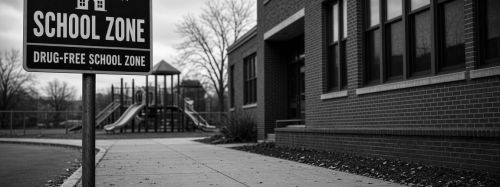
G.L. c. 94C, § 32J — Enhanced Penalties for Drug Offenses Near Schools and Parks
Certain drug offenses committed near schools or public parks carry enhanced mandatory-minimum penalties under Massachusetts law. G.L. c. 94C, § 32J creates these “school zone” and “park zone” enhancements. The statute has been narrowed significantly since its original enactment—first in 2012 by reducing the school-zone radius from 1,000 feet to 300 feet and limiting the hours of applicability, and further by later amendments that added additional requirements for the enhancement to apply.
This expanded guide explains the current framework, the elements the Commonwealth must prove, how boundaries are measured, the mandatory-minimum consequences, and practical defense considerations.
What Triggers a School Zone or Park Zone Charge
Section 32J applies when a person violates certain underlying drug statutes (distribution, possession with intent to distribute, trafficking, sale of paraphernalia, and related offenses under §§ 32, 32A–32F, or 32I) while:
- In, on, or within 300 feet of the real property of a public or private accredited preschool, Head Start facility, elementary, vocational, or secondary school, if the violation occurs between 5:00 a.m. and midnight (whether or not school is in session); or
- Within 100 feet of a public park or playground.
Later amendments have further limited the circumstances in which the enhancement applies, requiring in many cases additional aggravating factors such as the use of violence or threats, possession of a firearm or certain weapons, directing the activities of another in a drug felony, or involvement of minors. Counsel should carefully examine the current version of the statute and the specific charging language.
Elements the Commonwealth Must Prove
After proving the underlying drug offense beyond a reasonable doubt, the Commonwealth must also prove:
- That the offense occurred within the applicable distance of a qualifying school or park; and
- For school-zone cases, that the offense occurred between 5:00 a.m. and midnight.
Lack of knowledge of the school or park boundaries is not a defense. The Commonwealth is not required to prove that the defendant knew he or she was within the protected zone.
How Distance Is Measured
Distance is measured in a straight line from the location of the offense to the real property comprising the school or park. The Commonwealth need not prove the precise boundary point if the measurement is taken from a location reasonably inferable to be on school property. Contiguous undeveloped school land is generally included within the school’s real property. Principals, police officers, and other witnesses with personal knowledge may testify to the nature of the school and its boundaries.
Mandatory Minimum Sentence
A conviction under § 32J carries a mandatory minimum term of imprisonment of two years. The sentence is consecutive—“from and after”—the sentence imposed for the underlying drug offense. A fine of not less than $1,000 nor more than $10,000 may also be imposed, but the fine cannot replace the mandatory term of imprisonment.
Because the school-zone or park-zone sentence does not begin until the underlying sentence is completed, the practical effect is a substantial increase in total time to be served.
Knowledge and Constitutional Challenges
Massachusetts courts have held that the lack-of-knowledge provision does not violate due process and that the consecutive mandatory sentence does not violate double-jeopardy principles. Challenges based solely on the defendant’s lack of awareness of the zone boundaries are therefore unlikely to succeed. Fact-specific challenges to the measurement, the nature of the property, or the applicability of later statutory limitations remain viable.
Defense Strategies
Effective defenses often focus on:
- Contesting the underlying drug offense itself (possession, intent, distribution, etc.);
- Challenging the accuracy of the distance measurement or the boundaries of the school or park property;
- Determining whether the property qualifies as a covered school, preschool, Head Start facility, park, or playground under the statute;
- Examining whether the time-of-day requirement is satisfied for school-zone cases;
- Analyzing whether any additional aggravating factors required by later amendments are present; and
- Negotiating a resolution of the underlying charge that avoids a school-zone or park-zone conviction.
Frequently Asked Questions
Does it matter that school was not in session?
No. The statute applies whether or not the school is in session, provided the other requirements (distance and, for schools, time of day) are met.
Is a kindergarten alone considered an “elementary school”?
Courts have held that a school consisting only of a kindergarten is not an “elementary school” for purposes of the statute.
Can the school-zone sentence run concurrently with the underlying sentence?
No. By statute the § 32J sentence must begin from and after the expiration of the sentence for the underlying offense.
Why Experienced Counsel Matters
School-zone and park-zone enhancements transform the sentencing exposure of an underlying drug case. Accurate measurement challenges, careful analysis of the current statutory requirements, and strategic negotiation of the underlying charge can make a decisive difference. An attorney familiar with both the drug statutes and the technical requirements of § 32J is essential.
Contact Criminal Defense Attorney William J. Barabino
If you or a loved one is facing a school-zone or park-zone drug charge, early and experienced representation is critical. The Law Office of William J. Barabino provides client-focused criminal defense throughout Massachusetts.
Call 781-393-5900 today for a confidential consultation.
Visit williambarabino.com for additional resources on drug offenses and related topics.
Related Blog Posts and Resources
You may also find these helpful:
Disclaimer: This article is for educational and informational purposes only and does not constitute legal advice. The school-zone statute has been amended multiple times; the precise requirements applicable to any given case depend on the date of the alleged offense and the current text of G.L. c. 94C, § 32J. Reading this material does not create an attorney-client relationship. For advice regarding your particular situation, consult a qualified Massachusetts criminal defense attorney.