Larceny from the person means stealing property directly from someone, or from the area right around them while they are there. Think of a wallet lifted from a pocket, or a phone taken from a table in front of its owner. Under G.L. c. 266, § 25, it is a felony no matter how little the property was worth. District Court Instruction 8.560 sets out what the Commonwealth must prove beyond a reasonable doubt.
At a Glance: Larceny from the Person
Felony
at any value, even a few dollars
Up to 5 years
in state prison, or up to 2½ years in jail
From the person
or from their area of control, in their presence
No force needed
force or fear would make it robbery instead
The law: G.L. c. 266, § 25(a)–(b); District Court Instruction 8.560
What the Law Covers
Section 25(b) says simply: "Whoever commits larceny by stealing from the person of another shall be punished." Instruction 8.560 explains that this means wrongfully taking personal property from another person, or from the area immediately under their control, intending to deprive them of it permanently.
Two things set it apart from ordinary theft:
Value doesn't matter. For larceny by stealing under § 30, value decides whether it is a misdemeanor or a felony. Under § 25, value plays no part in the punishment.
No force is needed. Larceny from the person is a lesser included offense of robbery. The difference is that robbery requires force or a threat of force.
What the Commonwealth Must Prove
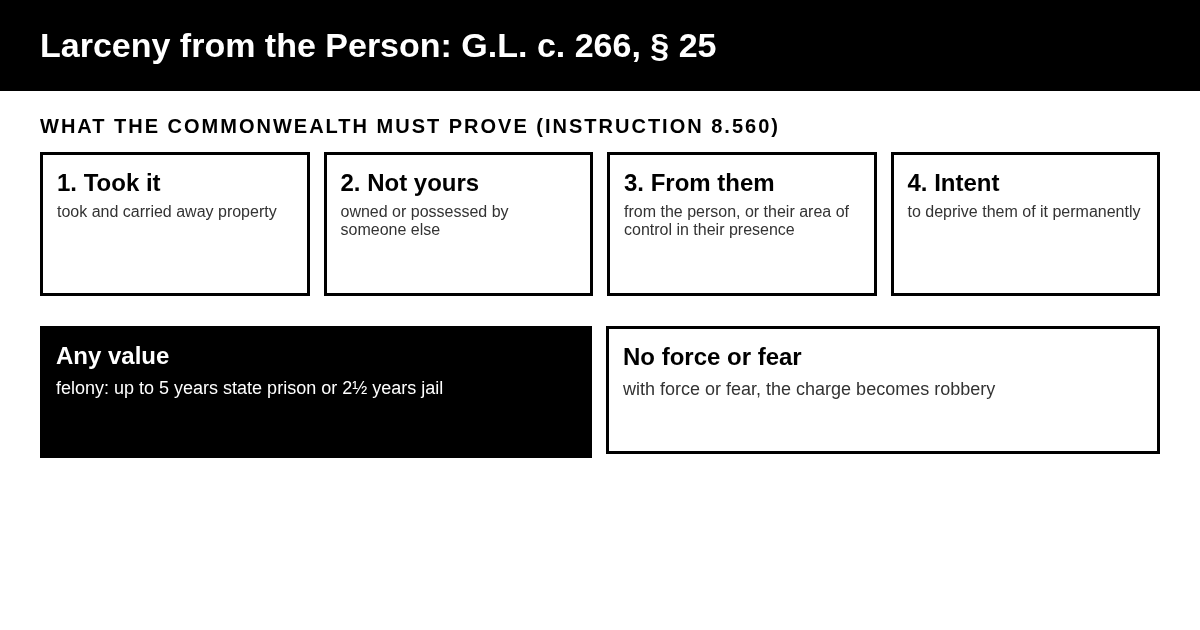
Under Instruction 8.560, the Commonwealth must prove four things beyond a reasonable doubt:
You took and carried away property.
The property was owned or possessed by someone else.
You took it from that person, or from their area of control while they were present.
You intended to deprive them of it permanently. Read more about criminal intent.
Pickpocketing vs. Purse Snatching
The notes to Instruction 8.560 draw a practical line. An ordinary pickpocketing is usually larceny from the person, even if the victim notices, because no intimidation or real violence is involved. But snatching a purse from someone who is aware of it is treated as enough force for robbery, even if it happens too fast to resist.
Victim 65 or Older
Section 25(a) is a separate, more serious form of the charge when the person was 65 or older. The Commonwealth must prove the person's age as an extra element. The notes to Instruction 8.560 say jurors may consider the person's appearance as one factor, but appearance alone isn't enough unless the person is very obviously elderly. A repeat conviction under § 25(a) carries a mandatory minimum sentence.
Section 25 has no separate provision for victims with a disability. That protection appears in the general larceny statute, § 30(5), which covers victims 60 or older or with a disability.
Penalties
Larceny from the person, § 25(b): up to 5 years in state prison, or up to 2½ years in jail. Because it can be punished in state prison, it is a felony. Read more about misdemeanors and felonies.
Victim 65 or older, § 25(a): the same maximum, up to 5 years in state prison or 2½ years in jail.
Defenses
Not "from the person": if the item wasn't on the person, or within their control while they were there, this charge doesn't fit.
No intent to keep it: picking up something by mistake, or believing it was yours, is not larceny.
Identification: these incidents are fast and often happen in crowds. Eyewitness accounts and video deserve close scrutiny.
Age: for § 25(a), the Commonwealth must actually prove the person was 65 or older.
Why a Lawyer Matters
Larceny from the person is a felony even when the item is worth a few dollars. Cases often turn on where the item was, where the owner was, and whether the right person was identified. I have defended criminal cases for 23 years. If you have been charged with larceny from the person, call 781-393-5900.
Related Charges
Larceny by stealing (G.L. c. 266, § 30): ordinary theft, where value decides misdemeanor or felony.
Shoplifting (G.L. c. 266, § 30A): theft from a store rather than from a person.
Larceny by check (G.L. c. 266, § 37): paying with a check you know won't clear.
Identity fraud (G.L. c. 266, § 37E): using another person's identifying information.
Disclaimer
This information is for general educational purposes only and not legal advice. Laws change. For advice about a specific case, speak with a licensed Massachusetts attorney.