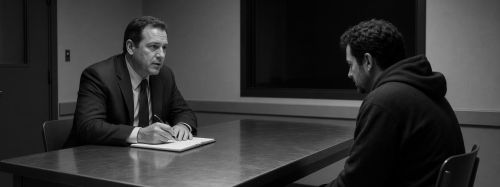
Many criminal cases are built on a statement made in an interview room, a cruiser, or a phone call with a friendly detective who says, “We just want to hear your side.” Once said, it usually cannot be taken back.
Massachusetts gives people under police questioning real protections, and in several areas they go further than federal law. This guide explains how they work and how to protect yourself before and after an arrest.
What Counts as an Interrogation, and When Are You “In Custody”?
An interrogation includes direct questioning and other words or actions by police designed to draw out an incriminating response. The key distinction is custodial versus non-custodial questioning, because Miranda warnings are required only for custodial interrogation.
The test is whether a reasonable person in your position would have believed he or she was not free to leave. Courts consider where the questioning took place, whether officers conveyed that you were a suspect, whether the interview was aggressive or informal, and whether you were actually free to end it, often shown by whether it ended in an arrest. Commonwealth v. Groome, 435 Mass. 201, 211–212 (2001).
Police often prefer non-custodial interviews. A detective calls and asks you to “come down and clear this up,” then tells you that you are not under arrest and can leave anytime. If a court later agrees you were free to go, no warnings were required, and what you said can generally be used against you.
You do not have to accept that invitation. Unless you are under arrest or a court has ordered you to appear, you can politely decline and ask that any contact go through your lawyer. If police have reached out before any charge has been filed, that is the best time to get advice. Our page on representing people under police investigation explains how a lawyer can handle that contact and find out what police are looking into, without you sitting for an interview.
Miranda Warnings and Article 12
Under Miranda v. Arizona, 384 U.S. 436 (1966), before custodial interrogation police must tell you that you have the right to remain silent, that anything you say can be used against you, and that you have the right to a lawyer, appointed if you cannot afford one. For more on the warnings themselves, see Miranda Rights at 50.
Article 12 of the Massachusetts Declaration of Rights also protects against self-incrimination, and the Supreme Judicial Court (SJC) has repeatedly read it more broadly than the Fifth Amendment. For example, the SJC has held that physical evidence derived from unwarned statements, where warnings were required, is presumptively excludable under Massachusetts law, even though federal law does not require that result. United States v. Patane, 542 U.S. 630 (2004); Commonwealth v. Martin, 444 Mass. 213 (2005).
If you waive your rights, the Commonwealth must prove the waiver was knowing, intelligent, and voluntary beyond a reasonable doubt. Commonwealth v. Day, 387 Mass. 915, 920–921 (1983).
How to Invoke Your Right to Remain Silent and Your Right to a Lawyer
Under federal law, a suspect must invoke the right to silence or to counsel unambiguously. In Davis v. United States, 512 U.S. 452 (1994), “Maybe I should talk to a lawyer” was not enough. In Berghuis v. Thompkins, 560 U.S. 370 (2010), nearly three hours of near-silence did not invoke the right to remain silent.
Massachusetts is somewhat more protective before a waiver. In Commonwealth v. Clarke, 461 Mass. 336 (2012), the SJC held that Article 12 does not require that heightened clarity from a suspect who has not yet waived his rights, and found that a suspect who shook his head when asked if he wanted to talk had invoked his right to silence, which police then had to “scrupulously honor.” But after a person waives and starts talking, hedged statements often fail. Clarke describes an earlier case where “I guess I’ll have to have a lawyer for this” did not end questioning. Commonwealth v. Pennellatore, 392 Mass. 382, 387 (1984).
The lesson: do not count on a generous reading. Say it plainly:
- “I am going to remain silent.”
- “I want a lawyer. I will not answer questions without my lawyer.”
Once you clearly ask for a lawyer, questioning must stop until a lawyer is present unless you restart the conversation. Edwards v. Arizona, 451 U.S. 477 (1981). So after you invoke, stop talking, including small talk on the ride to the station.
When a Lawyer Is Trying to Reach You
Families often call a lawyer while a loved one is still being questioned. Federal law does not require police to tell the suspect. Moran v. Burbine, 475 U.S. 412 (1986). Massachusetts does. In Commonwealth v. Mavredakis, 430 Mass. 848 (2000), the SJC held under Article 12 that when an attorney identifies himself or herself to police as counsel acting for a suspect, police must stop questioning and tell the suspect immediately, whether the attorney calls or comes to the station. Id. at 861. Without that information, a waiver is not knowing and intelligent. If someone you love is being questioned, call a defense lawyer right away.
Voluntariness and the Humane Practice Rule
Even a properly warned statement is inadmissible unless it was voluntary, the product of a rational intellect and free will rather than coercion, threats, promises, exhaustion, intoxication, or mental illness. The Commonwealth must prove voluntariness beyond a reasonable doubt before any statement to police goes to the jury. Commonwealth v. Tavares, 385 Mass. 140, 152 (1982).
Under the “humane practice” rule, the judge first decides voluntariness outside the jury’s presence. If the statement is admitted and voluntariness is a live issue at trial, the jury is told not to consider it unless the jurors are satisfied beyond a reasonable doubt that it was voluntary. That gives the defense two chances to challenge a statement.
Recording and the DiGiambattista Instruction
Not every interrogation is recorded, and some are only partly recorded. In Commonwealth v. DiGiambattista, 442 Mass. 423 (2004), the SJC declined to exclude unrecorded statements and instead created a jury instruction. When the prosecution offers a statement from a custodial interrogation, or an interrogation at a place of detention, and there is not at least an audio recording of the complete interrogation, the defendant is entitled, on request, to an instruction that:
- the SJC has expressed a preference that such interrogations be recorded whenever practicable;
- because there is no recording, the jury should weigh evidence of the alleged statement with great caution and care; and
- where voluntariness is a live issue and a humane practice instruction is given, the absence of a recording permits, but does not compel, the jury to conclude that the Commonwealth has not proved voluntariness beyond a reasonable doubt.
The instruction applies whatever the reason for not recording.
Deception, Trickery, and Minimization
Police may use some deception, and a lie by an officer does not automatically void a confession. False statements are a relevant factor on waiver and voluntariness but do not necessarily require suppression. Commonwealth v. Selby, 420 Mass. 656 (1995); DiGiambattista, 442 Mass. at 432–433. Still, the SJC “expressly disapprove[s] of the tactics of making deliberate and intentionally false statements to suspects in an effort to obtain a statement.” Commonwealth v. Jackson, 377 Mass. 319, 328 n.8 (1979).
Minimization, where officers suggest the crime was understandable or not that serious, can imply leniency without an express promise. Neither false evidence claims nor minimization automatically makes a confession involuntary; courts weigh the totality of the circumstances. Combined, they can cross the line, as Attorney Barabino’s own case shows.
If a detective says the video or DNA already proves everything, do not assume it is true.
Attorney Barabino’s Case: Commonwealth v. DiGiambattista (2004)
Commonwealth v. DiGiambattista, 442 Mass. 423 (2004), is a landmark Massachusetts interrogation decision. Attorney William Barabino represented the defendant before the Supreme Judicial Court, together with attorney John A. Baccari.
In an unrecorded arson interrogation at a fire station, officers brought in a thick “evidence” folder that was actually stuffed with blank paper and newspaper clippings, along with a blank videotape labeled to suggest surveillance footage, and asked whether he would show up on that tape. They also downplayed the crime, stressing that no one was hurt. He confessed, but his account of how and where the fire started was completely contrary to the forensic evidence, and other details were shown to be impossible.
The SJC held that the combination of trickery and implied promises meant the Commonwealth could not prove the confession voluntary. The confession should have been suppressed, and the conviction was reversed. The court also announced the recording instruction described above: jurors must be told, on request, to weigh a statement from an unrecorded custodial interrogation, or an unrecorded interrogation at a place of detention, with great caution and care.
More than two decades later, that instruction remains a starting point for challenging any unrecorded interrogation in Massachusetts. Read more: Massachusetts Lawyers Weekly Reports on Attorney Barabino’s Landmark Case.
The Rosario Six-Hour Rule
After an arrest, you must be brought to court without unreasonable delay. Under Commonwealth v. Rosario, 422 Mass. 48, 56–57 (1996), a statement is not excluded for delay in arraignment if it was made within six hours of arrest, day or night, or after an informed and voluntary written or recorded waiver of prompt arraignment. A later statement without a waiver is barred, although the clock can start later if the person was incapacitated by drugs or alcohol and can be tolled for emergencies not caused by police. For the booking-to-court timeline, see What Happens When You’re Arrested in Massachusetts.
Juveniles and the Interested Adult Rule
Massachusetts gives young people extra protection. Under Commonwealth v. A Juvenile, 389 Mass. 128 (1983):
- For a juvenile under 14, a waiver of Miranda rights is not effective unless a parent or other interested adult was present, understood the warnings, and had the opportunity to explain the rights to the juvenile.
- For a juvenile 14 or older, there should ordinarily be a meaningful opportunity to consult with an interested adult. Without it, a waiver can stand only if the circumstances show a high degree of intelligence, experience, knowledge, or sophistication on the juvenile’s part.
Commonwealth v. Smith, 471 Mass. 161 (2015), extended the rule to 17-year-olds, prospectively. An interested adult must not be antagonistic to the juvenile and must be able to appreciate the juvenile’s situation. See Commonwealth v. Philip S., 414 Mass. 804 (1993).
Silence, Jail Calls, and False Confessions
Remaining silent is not an admission of guilt. After Miranda warnings, the prosecution cannot use your silence to impeach you. Doyle v. Ohio, 426 U.S. 610 (1976). Massachusetts also tightly limits using silence in the face of an accusation, as explained in Admission by Silence. What you do say, including lies or false alibis, can be offered as consciousness of guilt.
Jail calls are routinely recorded, and cellmates can report what you say to police, sometimes for a benefit. See jailhouse informants. Discuss your case only with your lawyer.
False confessions are real. Long interrogations, fatigue, fear, youth, intellectual disability, and the belief that confessing is the only way home can lead innocent people to confess.
Motions to Suppress Statements
The usual remedy for a violation is a pretrial motion to suppress. A motion may argue that you were in custody and not warned, that police ignored your invocation, that your waiver was not knowing and intelligent, that the statement was involuntary, that police withheld a lawyer’s efforts to reach you, that the Rosario rule was violated, or that a juvenile was denied an interested adult. Evidence from an unlawful stop or search can also be challenged; see Search and Seizure.
Practical Advice If Police Want to Question You
- Stay calm and polite. Do not argue or resist.
- If arrested, give accurate identifying information. Giving a false name or identifying information after an arrest is a separate crime. G.L. c. 268, § 34A.
- Say clearly, “I am going to remain silent, and I want a lawyer.” Then stop talking.
- Do not agree to a “quick chat,” phone interview, or polygraph without a lawyer.
- Do not discuss your case with cellmates, on jail phones, by text, or on social media.
- Afterward, write down who questioned you, when, where, and whether you were warned or recorded.
Frequently Asked Questions
Do I have to go to the police station if a detective calls and asks me to come in?
No. Unless you are under arrest or ordered to appear by a court, an interview is voluntary. You can decline and have the detective contact your lawyer.
If the police never read me my rights, will my case be dismissed?
Usually not. Miranda applies only to custodial interrogation, and the usual remedy for a violation is suppression of the statement (and in Massachusetts possibly evidence derived from it), not dismissal.
Can police lie to me during an interrogation?
Sometimes. Deception is a factor in whether a statement was voluntary but does not automatically make it inadmissible. Combined with implied promises of leniency, it can.
Talk to a Lawyer Before You Talk to the Police
If police have asked you to come in and talk, or you have been arrested and questioned, the Law Office of William J. Barabino in Medford can help. Attorney Barabino has over 23 years of experience defending people in Massachusetts courts and represents clients throughout Greater Boston.
Call 781-393-5900 for a confidential consultation.
Related Articles
Disclaimer
This article is for general educational purposes only and is not legal advice. Massachusetts and federal law on interrogations, Miranda, and suppression of statements continues to develop, and every case turns on its own facts. Reading this page does not create an attorney-client relationship. If you are being investigated or have been questioned by police, consult a licensed Massachusetts criminal defense attorney about your situation.