An affray is a fight in a public place that frightens people who are lawfully there. It is a common law crime in Massachusetts. G.L. c. 277, § 39 defines it as the "fighting together of two or more persons in a public place to the terror of the persons lawfully there." District Court Instruction 6.100 sets out what the Commonwealth must prove beyond a reasonable doubt. Nothing in the definition of affray prevents a person charged with it from asserting self-defense or defense of another.
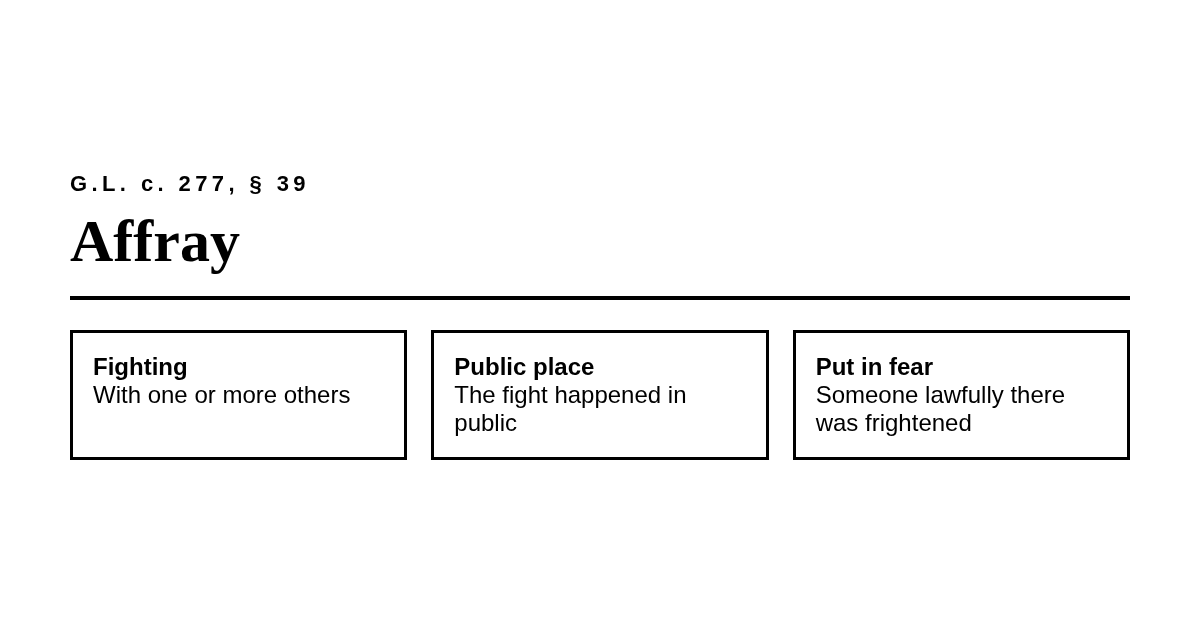
At a Glance: Affray
Fighting
with one or more other people
Public place
the fight happened in public
Put in fear
someone lawfully there was frightened by the fight
No set penalty
the sentence follows common usage and practice
The law: G.L. c. 277, § 39; G.L. c. 279, § 5; District Court Instruction 6.100 (May 2014)
What the Commonwealth Must Prove
Under Instruction 6.100, the Commonwealth must prove three things beyond a reasonable doubt:
You fought with one or more other people.
The fighting took place in a public place.
At least one person who was lawfully present in that public place was put in fear as a result of the fighting.
It does not matter whether you and the other people were on the same side or opposing sides.
What Counts as Fighting
Fighting is the use of physical force or violence, or any threat to immediately use such force or violence. A threat of immediate force can be enough; no one has to be hurt.
Lawful Presence and Fear
The person who was frightened must have been lawfully present in the public place. Why that person was there does not matter. If no one lawfully present was put in fear, the charge fails.
Penalties
No statute sets a penalty for affray. Under G.L. c. 279, § 5, when no punishment is provided by statute, the court imposes a sentence that conforms to the common usage and practice in Massachusetts, according to the nature of the crime.
Defenses
Self-defense or defense of another: you used force to protect yourself or someone else.
Not fighting: you did not use or threaten immediate force, for example you were trying to break up the fight or leave.
Not a public place: the incident happened somewhere that was not public.
No one put in fear: no one lawfully present was frightened by the fighting.
Identification: in a crowd or a fast-moving fight, who did what is often disputed, and video can help or hurt.
Why a Lawyer Matters
Affray charges often come out of bar fights, street fights, and crowd incidents, and they are frequently charged along with assault and battery or disorderly conduct. Self-defense and identification are often where these cases turn. I have defended criminal cases for 23 years. If you have been charged with affray, call 781-393-5900.
Related Charges
Assault and battery (G.L. c. 265, § 13A): an intentional, unjustified touching.
Disorderly conduct (G.L. c. 272, § 53): fighting or threatening behavior that causes public inconvenience or alarm.
Disturbing the peace (G.L. c. 272, § 53): conduct that disturbs others in a public place.
Disclaimer
This information is for general educational purposes only and not legal advice. Laws change. For advice about a specific case, speak with a licensed Massachusetts attorney.