Disturbing the peace is a crime in Massachusetts under G.L. c. 272, § 53(b). It is one of the most common charges after a loud argument, a late-night party, or a scene outside a bar. A first offense carries only a fine. A second offense can mean jail. District Court Instruction 7.200 sets out what the Commonwealth must prove beyond a reasonable doubt.
At a Glance: Disturbing the Peace
$150 max fine
for a first offense, with no jail
3 elements
disruptive conduct, done intentionally, that disturbed someone
1 person
must actually have been annoyed or disturbed
Speech limits
offensive words alone usually aren't enough
The law: G.L. c. 272, § 53(b); District Court Instruction 7.200 (2009 Edition)
What the Commonwealth Must Prove
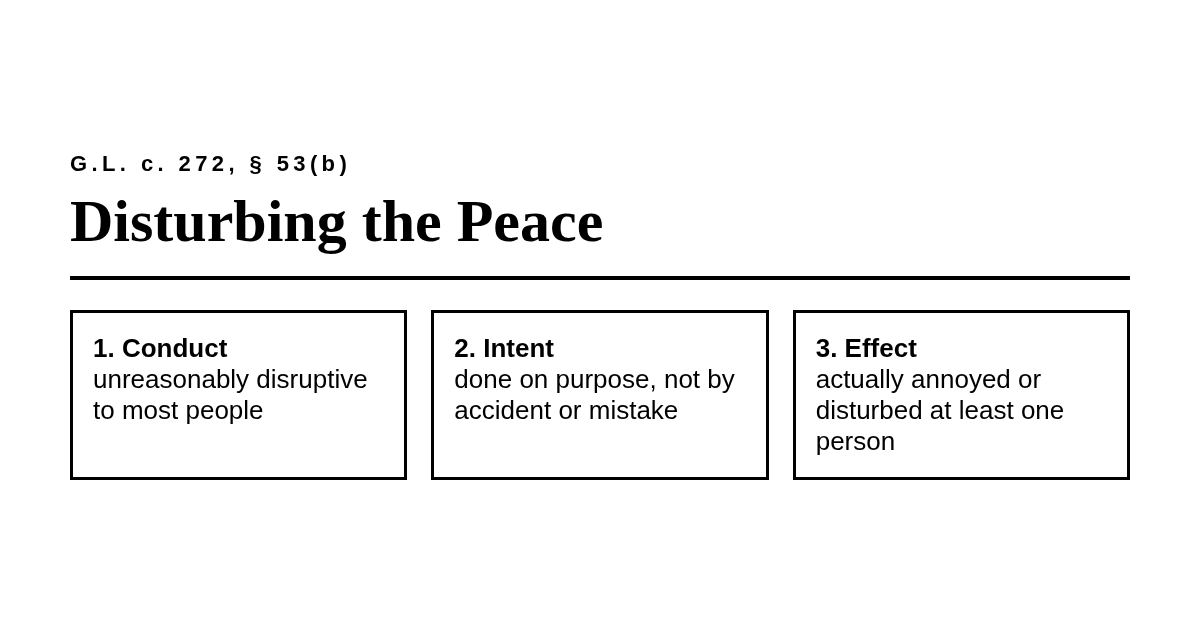
Under Instruction 7.200, the Commonwealth must prove three things beyond a reasonable doubt:
Unreasonably disruptive conduct. You did something most people would find unreasonably disruptive.
Intent. You did it intentionally, not by accident or mistake.
An actual disturbance. Your conduct did in fact annoy or disturb at least one person.
The instruction adds that the acts must have been voluntary, unnecessary, and contrary to normal standards of conduct.
What Counts as Unreasonably Disruptive
The instruction gives these examples:
making loud and disturbing noise;
tumultuous or offensive conduct;
throwing objects in a populated area;
threatening, quarreling, fighting, or challenging others to fight;
personal insults that amount to "fighting words," meaning words so offensive they are inherently likely to provoke an immediate violent reaction.
Time and Place Matter
The jury considers all the circumstances, including the time and location. The question is whether you disturbed the peace and quiet of at least one person in that area, or interfered with at least one person's normal activity. Loud music at 2 p.m. on a busy street is not the same as shouting at 2 a.m. in a quiet neighborhood. The instruction notes that the fact that police were called can support an inference that people nearby were disturbed.
Speech and the First Amendment
The statute can't be applied to offensive or abusive language alone unless that language falls outside First Amendment protection. Fighting words that tend to provoke an immediate breach of the peace are not protected. Profanity aimed at a police officer, without more, generally is not enough. But adding protected speech to otherwise illegal conduct is not a defense, and loud speech late at night in a residential neighborhood, where people are disturbed in their homes, can be punished.
Penalties
First offense: a fine of up to $150. No jail.
Second or later offense: up to 6 months in a jail or house of correction, a fine of up to $200, or both.
Students: an elementary or secondary school student can't be found delinquent under this subsection for conduct inside school buildings, on school grounds, or at school-related events.
Defenses
Not unreasonably disruptive: ordinary noise, an argument at normal volume, or conduct that fits the time and place.
No one was actually disturbed: the Commonwealth must prove at least one person was annoyed or disturbed.
Accident or necessity: the conduct must be intentional, voluntary, and unnecessary.
Protected speech: words alone, short of fighting words, are generally protected.
Identification: in a crowd, the Commonwealth must prove you were the one causing the disturbance.
Why a Lawyer Matters
A disturbing the peace charge may seem minor, but it creates a criminal record, and it is often charged alongside more serious offenses. A first conviction also exposes you to jail on any later charge. The right approach can often resolve the case without a conviction. I have defended criminal cases for 23 years. If you have been charged with disturbing the peace, call 781-393-5900.
Related Charges
Disorderly conduct (G.L. c. 272, § 53): the companion charge in the same subsection, focused on public conduct.
Affray: fighting in a public place that frightens others.
Threats (G.L. c. 275, § 2): threatening to commit a crime against a person or property.
Disclaimer
This information is for general educational purposes only and not legal advice. Laws change. For advice about a specific case, speak with a licensed Massachusetts attorney.