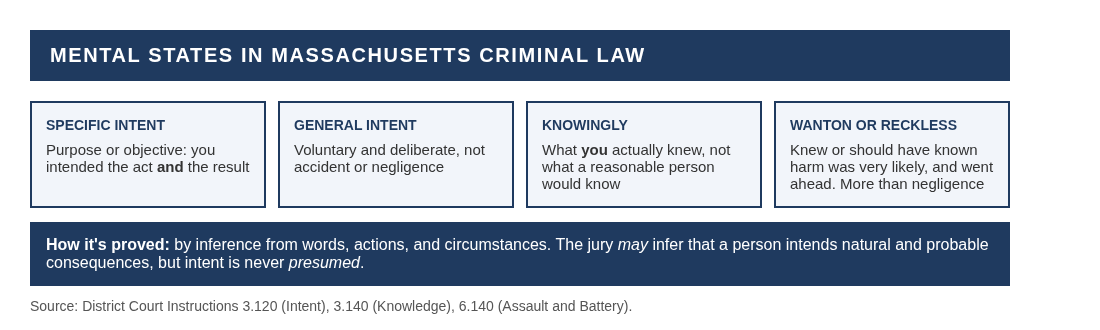
Most crimes require proof of a guilty state of mind, not just a guilty act. In Massachusetts, the jury instructions describe several mental states. Specific intent means acting with a purpose. General intent means acting deliberately, not by accident. Knowledge means knowing particular facts. Wanton or reckless conduct means going ahead despite a very high risk of harm. Because no one can look inside another person's mind, intent is usually proved by inference from words, actions, and circumstances. Whatever mental state a charge requires, the Commonwealth must prove it beyond a reasonable doubt.
At a Glance: Criminal Intent
Specific intent
your purpose or objective: intending the result, not just the act
General intent
acting voluntarily and deliberately, not by accident or negligence
Proved by inference
from words, actions, and circumstances; never presumed
Recklessness ≠ negligence
a very high risk of substantial harm, taken anyway
The source: District Court Instructions 3.100 (Inferences), 3.120 (Intent), 3.140 (Knowledge), 3.230 (Transferred Intent), 3.580 (Consciousness of Guilt), and 6.140 (Assault and Battery, reckless conduct)
Specific Intent: Purpose or Objective
Some crimes require proof that you acted with a particular intent, such as intent to steal or intent to cause injury. Instruction 3.120 defines a person's intent as their purpose or objective. Specific intent means more than intending the act itself: you must have consciously intended a certain result as well. If the Commonwealth cannot prove that purpose, a specific-intent crime is not proved, even if the act happened.
General Intent: Deliberate, Not Accidental
Many other crimes require only general intent. Under Instruction 3.120, acting "intentionally" has its ordinary meaning: acting voluntarily and deliberately, and not because of accident or negligence. You need not have known you were breaking the law, but you must have intended the act that makes up the offense. This is why an accident is a defense to a general-intent crime. The notes to the instruction also say that "wilful" today simply means intentional, as opposed to accidental. It does not require ill will.
Transferred Intent: When the Wrong Person Is Harmed
Sometimes a person means to harm one person but ends up harming someone else. Massachusetts calls this "transferred intent." Under Instruction 3.230, if you intended to harm one person but harmed another instead, your intent carries over to the person who was actually harmed. The law treats it as if you meant to harm that person all along.
Here's an example. Someone swings at one person, misses, and hits a bystander. The intent to hit the first person transfers to the bystander. It doesn't help to say "I never meant to hit them."
Transferred intent doesn't lower the bar. It only moves the intent the Commonwealth has already proved. If there was no intent to harm anyone in the first place, there is nothing to transfer.
How Intent Is Proved
It is impossible to look directly into someone's mind, so the jury may consider your actions and words and all the surrounding circumstances. That means intent and knowledge are almost always proved by inference.
Instruction 3.100 calls an inference a permissible deduction from evidence the jury has accepted as believable. Inferences are small steps in reasoning: you take known information, apply life experience, and draw a conclusion. The instruction gives a simple example. If your mailbox was empty when you left in the morning and has mail in it when you get home, you can infer that the mail was delivered, even though you didn't see it happen. Another example: if your son leaves the house with an umbrella without saying anything, you can infer that he thinks it's raining and that he intends to go out in it. Those are inferences about knowledge and intent.
An inference does not have to be the only possible conclusion, but it must be reasonable and supported by the evidence. And all the evidence and inferences together must still prove guilt beyond a reasonable doubt.
For intent in particular, the jury may infer that a person intends the natural and probable consequences of acts they do intentionally, unless the evidence convinces them otherwise. That inference is permitted, not required. The notes to Instruction 3.120 say a judge may not tell a jury that a person is "presumed" to intend those consequences, because that would shift the burden of proof onto the defendant.
What Your Conduct Can Show (Consciousness of Guilt)
Prosecutors sometimes argue that what a person did after an incident shows a guilty mind. This is called "consciousness of guilt." Instruction 3.580 lists the usual examples:
Flight: running off after learning you were about to be arrested or charged.
False statements: knowingly telling police something untrue, or giving a false name.
Hiding or destroying evidence: trying to conceal, destroy, or falsify evidence in the case.
The instruction also covers trying to intimidate or bribe a witness.
The jury doesn't have to treat any of this as a sign of guilt. Under the instruction, jurors should draw that conclusion only if it's reasonable in light of everything in the case. They're also told two important things. First, an innocent person might do these things for many reasons, like fear, panic, or confusion. Second, feeling guilty isn't the same as being guilty, because innocent people sometimes feel guilty too.
Most important, this kind of evidence is never enough by itself to convict anyone. The jury can weigh it only along with all the other evidence.
Knowingly
When a crime requires that you acted "knowingly," Instruction 3.140 asks what you actually knew at the time about the facts that make up the crime. Like intent, knowledge is judged from your actions, words, and the surrounding circumstances. The instruction offers an example. When contraband is found in open view in an area a person controls, it may be reasonable to infer that the person knew it was there.
Knowledge is personal. The jury may use the circumstances to draw reasonable inferences, but in the end it must decide what you actually knew, not what a reasonable person would have known.
"Knowingly" also means voluntarily and intentionally, not by mistake, accident, negligence, or other innocent reason. Knowing that a law makes the act a crime is generally not required, because ignorance of the law is generally not an excuse.
Wanton or Reckless Conduct
Some crimes, such as assault and battery by reckless conduct, can be committed without any intent to injure. Under Instruction 6.140, you act recklessly if you knew, or should have known, that your actions were very likely to cause substantial harm to someone, and you ran that risk and went ahead anyway. Negligence, meaning acting in a way a reasonably careful person would not, is not enough. Recklessness also counts even if you didn't realize the danger, as long as a reasonable person who knew what you knew would have recognized it. The notes to Instruction 3.120 say wanton or reckless conduct is often treated as equivalent to intentional conduct.
Intoxication and Mental Condition
Under the notes to Instruction 3.120, when the evidence supports it, you are entitled to an instruction that intoxication with alcohol or drugs, or a mental condition, may negate specific intent.
Why a Lawyer Matters
Intent is often the most contested part of a criminal case, and it is almost always proved with circumstantial evidence. Showing the jury the innocent explanation, the accident, or the gap in the Commonwealth's inferences can decide the outcome. I have defended criminal cases for 23 years. If you have been charged with a crime, call 781-393-5900.
Entrapment: a defense when the intent to commit the crime came from the government.
Beyond a reasonable doubt: the standard the Commonwealth must meet on every element, including intent.
Disclaimer
This information is for general educational purposes only and not legal advice. Laws change. For advice about a specific case, speak with a licensed Massachusetts attorney.